



Quinnipiac students and faculty launch AI-powered ScrapDish app to help reduce household food waste
April 30, 2026
April 30, 2026

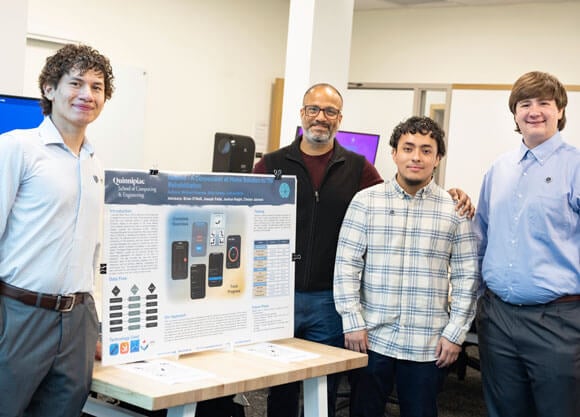
Chetan Jaiswal, associate professor of computer science, Kruti Shah, assistant professor of software engineering, and Dana White, a registered dietitian and clinical professor of health and exercise science, collaborated with students Adelina Chocho, Megan Mohr and Reeya Patel to create ScrapDish, a mobile app that uses artificial intelligence to help users organize food items, reduce waste and simplify meal planning. The app is currently available on iOS, with an Android launch expected soon.
ScrapDish offers a modern solution to the growing issue of household food waste by helping users track ingredients and identify items that should be used before they expire. Users can build a digital pantry by scanning food items using advanced technologies such as YOLOv8 for fresh ingredient detection and Optical Character Recognition (OCR) to capture expiration dates from packaged foods.
The app organizes ingredients in one place, making it easier for users to plan meals and reduce the stress of deciding what to cook. ScrapDish also features an AI-powered recipe generator that creates personalized meal suggestions based on available ingredients while accommodating dietary preferences and allergies.
An integrated AI chatbot further enhances the experience by answering food-related questions in real time, providing users with guidance on ingredient substitutions, cooking suggestions and meal preparation.
“ScrapDish demonstrates how artificial intelligence can be applied to everyday challenges in a practical and meaningful way,” said Jaiswal. “By helping users better manage their food inventory and create meals from what they already have, the app encourages sustainable habits while making cooking more convenient.”
The project reflects the interdisciplinary collaboration between faculty and students, blending expertise in computer science, health and nutrition and artificial intelligence to address a real-world problem.
“Projects like ScrapDish showcase the innovation happening across Quinnipiac’s academic programs,” said Shah. “Students are gaining hands-on experience developing technology that can make a positive impact on people’s lives while tackling an important sustainability challenge.”
For the student developers, the project provided an opportunity to design a product that balanced functionality with ease of use. Chocho said the team focused on creating a user-friendly experience that would encourage long-term engagement.
“We wanted to simplify how users input and track ingredients because manual entry can become tedious,” said Chocho. “By offering multiple ways to add items and creating personalized, reliable recipe suggestions, we aimed to build something people would actually use and benefit from. It’s rewarding to see everything come together into a product we’re proud of."
Mohr said developing ScrapDish from concept to deployment gave the team firsthand experience building a product with real-world impact.
“It has been a great experience developing an app from scratch all the way to its deployment,” Mohr said. “A few of our testers are excited to use the app over the summer to cook and have already tried the recipes it generates with satisfaction. I'm ecstatic that my group and I were able to develop a product that people would enjoy using and would make a difference in people's lives."
Patel said the app evolved significantly from its original concept into a fully functional tool now available to users.
“It is now an AI-powered mobile application that helps users track ingredients in their pantry and reduce food waste by generating personalized recipes,” Patel said. “The AI recipe generation is my favorite feature of the app; it’s a great tool for finding creative meal ideas based on what you already have on hand, and I hope others find it just as inspiring to use. Throughout the process, we spent countless hours improving the app’s core functionality and user interfaces.”
White said, “Food waste is a common challenge for many households, and ScrapDish was designed to make healthy, sustainable cooking decisions easier. By combining nutrition expertise with artificial intelligence, the app helps people feel more confident about using ingredients they already have while reducing unnecessary waste.”
According to the U.S. Department of Agriculture, food waste remains a significant issue in American households, contributing to environmental strain and unnecessary costs for consumers. ScrapDish aims to address this challenge by helping users maximize the value of the food they already purchase.
The development of ScrapDish highlights Quinnipiac’s commitment to experiential learning and applied research, giving students the opportunity to collaborate with faculty on projects that combine emerging technologies with practical problem-solving.






















Quinnipiac Today is your source for what's happening throughout #BobcatNation. Sign up for our weekly email newsletter to be among the first to know about news, events and members of our Bobcat family who are making a positive difference in our world.
Sign Up Now