



Projects Day amplifies student innovation at School of Computing & Engineering
June 04, 2026
June 04, 2026
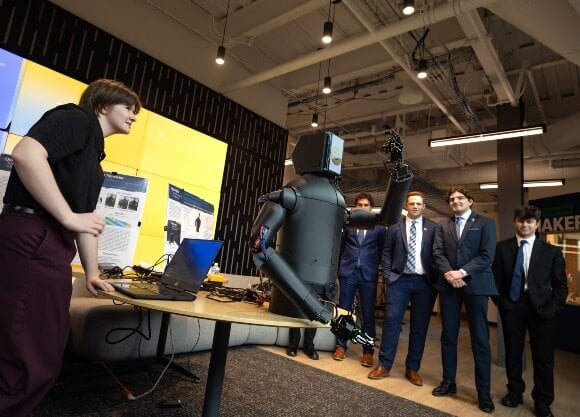
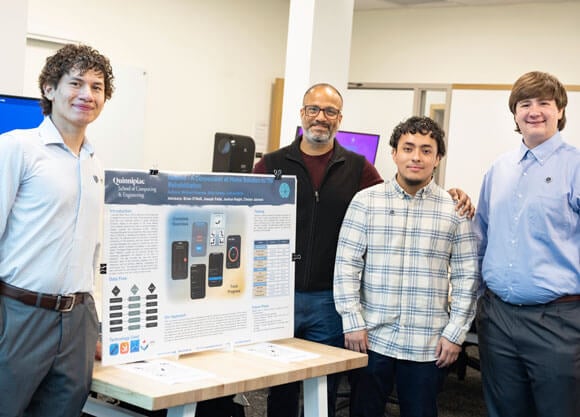
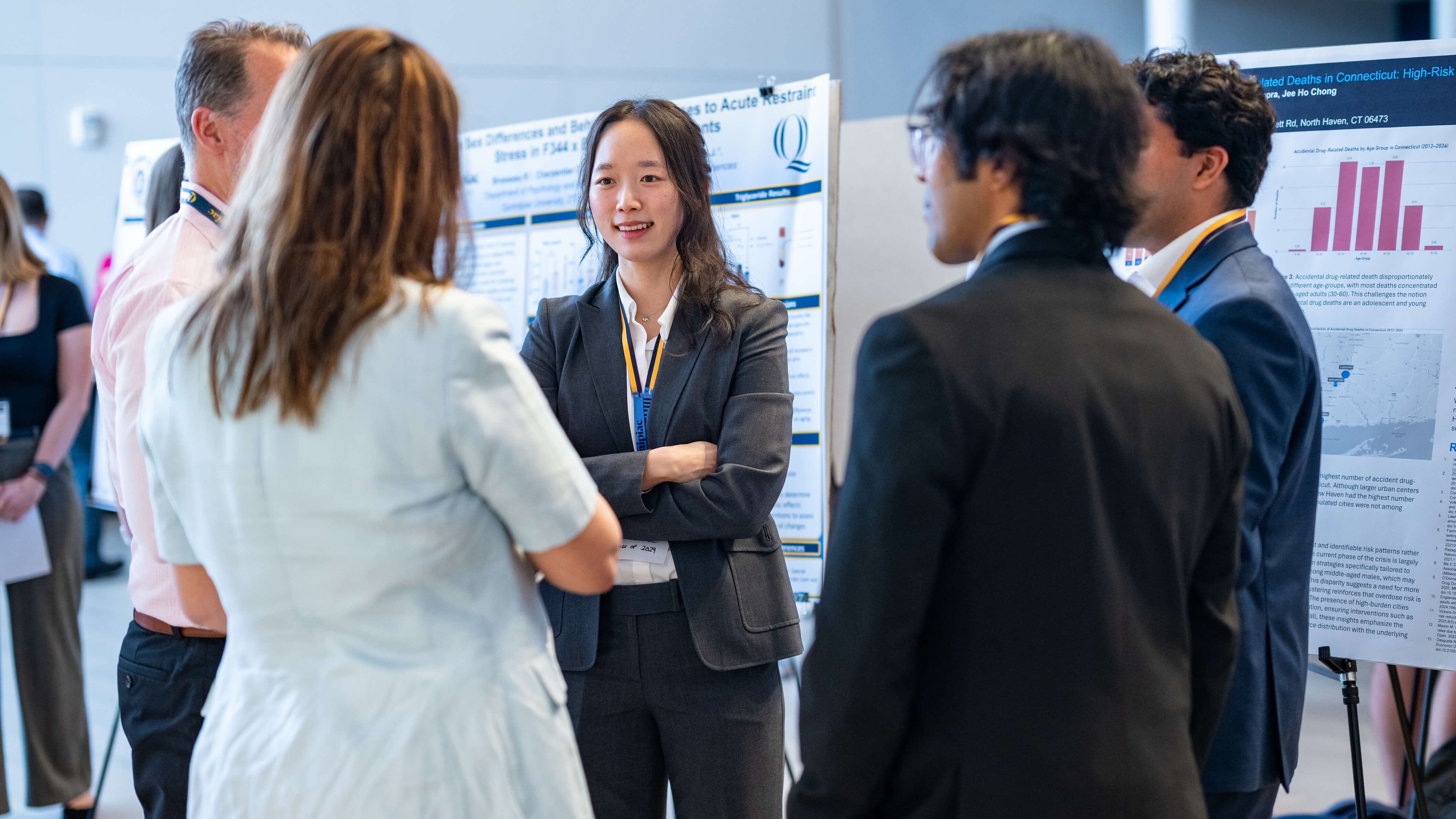
The dynamic event highlighted 50 unique projects developed by civil engineering, industrial engineering, mechanical engineering, software engineering and computer science students. They demonstrated working models, shared research posters and answered questions from project sponsors, industry professionals, faculty, alumni and supporters.
Marking its 10th anniversary this year, the School of Computing & Engineering launched its bachelor’s in artificial intelligence and computing and continues to strengthen programs and offer new disciplines in response to a changing world, such as its dual-degree program in cybersecurity.
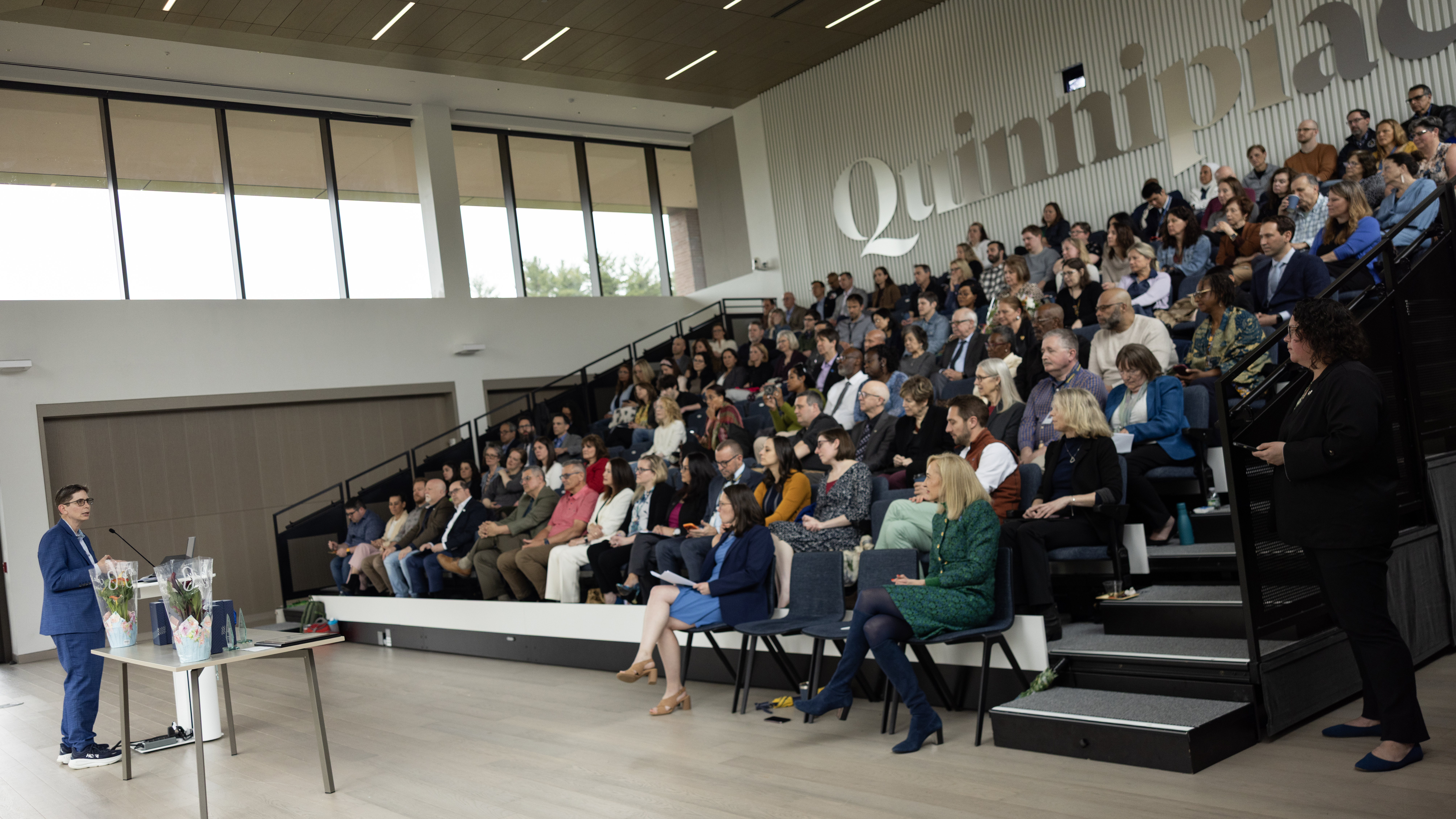
School of Computing & Engineering Dean Taskin Kocak said Projects Day is always a highlight of the academic year and his favorite day as it showcases students’ incredible talent, creativity and dedication.
“This year’s Projects Day is especially meaningful as we celebrate the tenth anniversary of our school. Over the past decade, the School of Computing & Engineering has grown tremendously, expanding our programs, expanding our partnerships and preparing our students to succeed and lead in an ever-evolving technological world. Today’s projects are a powerful reflection of that progress and the bright future ahead,” Dean Kocak said.
Dean Kocak also expressed Quinnipiac’s deep appreciation for the vital support of project sponsors who act as clients and help to guide student success.
“Your support plays a critical role in making many of these projects possible,” said Dean Kocak. “Your engagement with our students not only enriches their educational experience but also it helps bridge the gap between classroom and the real-world application.”
He encouraged all attendees to engage directly with students by asking questions, having them demonstrate their work and discuss the research and technology employed to arrive at their solutions.
“These conversations are often the most rewarding part of the day and truly highlight the depth of learning that takes place here,” Dean Kocak said.
Projects sponsored by Sikorsky from Stratford, Connecticut, offered opportunities for students to flex their skills in industrial engineering, mechanical engineering and cybersecurity.
Industrial engineering majors Matt Alduino ‘26, Briana Craig’ 26, Gavin Grim ‘26, Jack Krut ‘26, Juliann Lawson ‘26, Melanie Martinelli ‘26, Erin Swearingen ’26 and Eli Toomer ’26 tackled Sikorsky’s Process Automation and Improvement project.
With their computer-programmed automated guide vehicle (AGV) silently navigating the floor of their project display, Alduino described the team’s objective: to determine the impact of implementing automation technology within the company’s internal logistics and handling operations, based on a current manual process, and to provide recommendations for process improvement.
In addition to the AGV, the team’s technological solutions included a pick-and-place system to lift and load boxes and a simulated small-scale robotic ASRS (automated storage and retrieval system).
“Working on this was fun. We were able to problem-solve and use our best engineering judgement to get the project done and deliver what they needed,” said Alduino.
Working with client PTA Plastics from Oxford, Connecticut, mechanical engineering majors Andrew Miller ’26, Oliver Hanson ’26, Nicolas Ferriera ’26 and Zachary Kayton ’26 developed S.E.A.L. (Systems for Efficient Automated Loading). The automated gasket dispensing system dispenses foam gaskets individually, removes the backing liner and presents each gasket to an existing automation cell.
For project sponsor ParkPlus High Density Parking Systems, headquartered in New Jersey, mechanical engineering majors Kevin Murace ‘26, Charlyse LaMantia ‘26, Wilhelmina Kalis ’26, Gabe Sousa ‘26 and Alex Passaretti ’26 put their skills to the test to develop a vehicle tray.
The team said they especially enjoyed working with their client liaison, ParkPlus mechanical engineer and Quinnipiac School of Computing & Engineering alum Jake Fitzpatrick ’24.
“It was great to work with him because he knew the structure of our program. He knew our faculty and he knew what we’ve learned, so it made for a really quick connection,” said LaMantia.
The team was challenged with redesigning a vehicle tray which connects to ParkPlus AGV systems. Their goal was to reduce weight, lower production costs, increase shipping efficiency, shorten lead times and enhance reliability.
“We did all of this within Solidworks CAD modeling and FEA analysis as well to see how it performs under stress,” Murace explained. “They were very satisfied with our results because it was a lot lower than all of their original numbers.”
David Rodriguez of Roehm America LLC from Wallingford, Connecticut, visited Projects Day to see the work undertaken by Roehm America intern Shayne Hasipi ’26, MBA ’27. Hasipi has interned at the local manufacturing facility for three years.
“Shayne was a wonderful intern. He’s been a diligent self-starter who not only took direction but would just be an engineer and problem-solve for us,” said Rodriguez. “We had him for three summers and because of him, we actually turned it into a year-round internship.”
Hasipi said he appreciated Rodriguez’s support on Project Day and the opportunity to explain his part in the project.
“He’s seen me go from not knowing anything about engineering to now graduating, so it was kind of a nice send-off,” said Hasipi. “Also, I’m in the 3+1 program and I’ll be getting my MBA, so working with David has been really great because besides all the engineering things he taught me there, he taught me a lot about people and managerial skills.”
Hasipi contributed to his team’s design for robotic garage and recycling collector vehicle. In all, Projects Day featured a total of four different mechanical engineering student teams who developed their own versions of a robotic waste and recycling collector.
Working on behalf of client Sirius Structures from Hamden, Connecticut, civil engineering majors Taylor Byo ’26, Robert Cooper ’26 and James Deady ‘26 designed a third-floor addition to a 1930’s era West Haven school building that’s being renovated into a new apartment building. The project goal was to identify the most efficient third-floor design, achieved by considering column layout, material selection and load-bearing elements, all selected to ensure a safe and effective design.
For client Delve Underground from Boston, Massachusetts, civil engineering majors Alex Vouras ’26 and Sean Walsh ’26 developed a detailed construction plan for the design of a combined sewer overflow drop shaft in New York City. As part of the project, the drop shaft was designed by another team of civil engineering majors, Michaela Capano ’26, Kevin Clarke ‘26, Julia Duffy ‘26 and Matthew Woska ‘26. Their goal was to reduce the wet weather effluent into nearby water bodies by nearly 90%.
Across a broad range of computer science projects, Quinnipiac women’s golf student athlete and cybersecurity student Natalie Spiska ’26, MS ’27 put her talents to the test by developing Par for the Course, which explored the impact of technology on collegiate golf development and performance. She conducted research interviews with nine Division I college coaches to gather data.
“I decided to focus on technology in college golf because it’s typically an understudied area,” said Spiska. “The coaches were able to give their input on how technology has helped their program, how it’s been detrimental and just their overall perspective on it. At the end of the day, I found that every coach agreed that technology has been beneficial for their program, but there’s an underlying skepticism about using too much technology and relying too much on it.”
Also combining his interests and skills, computer science major and military veteran Philip Kwiatkowski ‘26 examined algorithmic bias in facial recognition systems used in national defense.
“Facial recognition technology is increasingly used in national defense and security settings,” Kwiatkowski noted. “While these systems are often viewed as objective, research has shown that facial recognition algorithms can perform unevenly across different demographic groups, leading to potential bias and misidentification.”
His goal was to create a better understanding of how fairness, transparency and trust should be addressed when deploying facial recognition technology in high-stakes environments. Kwiatkowski surveyed civilians, active-duty military and veterans about military use of AI facial recognition and analyzed existing research to explore how bias is understood, tolerated or challenged by different stakeholders.
Computer science major Brooks Jackson ’26 developed C.A.R.E., a governance framework for robust and equitable AI usage in oncology imaging. With AI becoming a major tool for detecting lung cancer in medical imaging, Jackson recognized ensuring both its reliability and fairness has become a critical challenge. Jackson’s thesis introduces the C.A.R.E. framework, a set of professional standards to raise the importance of accountability, reliability, equity and explainability in oncology AI models.
Several students put their brainwork toward solutions which will support their fellow Bobcats in the near future. Dual-degree software engineering and cybersecurity major Tyler Rinko ’26, MS ’27, dual-degree software engineering and computer science major Paul Zegarek ’26, MS ’27, dual-degree software engineering and computer science major Ethan Kulawiak ’26, MS ’27 designed an AI enabled essential skills analytics and resume building app. The project was sponsored by Assistant Dean for Student Experience and Career Development/Projects Day Committee Chair John Bau.
Among its many tools, the app can generate resume-ready bullets to help students contextualize their learning and core competencies based on specific course input provided by faculty, Rinko explained.
“The basic problem that we were trying to solve is we find that teachers are able to articulate the skills they are teaching better than a student who has just finished the class. We wanted to build a pipeline from the faculty to the student, so that the student could articulate those skills and industry problem-solving sets on their resumes and in interviews,” said Rinko.
Lynn Byers, professor of mechanical engineering, sponsored QChat, a chatbot designed by computer science majors Samantha Woodburn ‘26, Tuana Turhan ’26 and Thomas Rua ’26. QChat eliminates the need for students to search through university digital communications for information.
“I came into the project with the idea of how can we use AI to help our students at Quinnipiac? Let’s design a chatbot that lets students ask questions without figuring out where they need to go to find the answers,” Byers said.
Turhan said the team took the idea and ran with it.
“This chat has three different interfaces, for students, for professors and for the IT department. Everything is in here,” said Turhan.
The live, production ready system developed for the university community is designed to simplify navigation of complex academic and administrative systems by delivering accurate, context aware and citation supported responses. Leveraging natural language processing, retrieval augmented generation and secure integration with university infrastructure, the system goes beyond traditional search tools by understanding user intent and adapting responses based on prior interactions — while encrypting all personal data and maintaining FERPA compliance. By reducing routine inquiries and guiding users through digital portals, the assistant improves access for students and faculty while significantly reducing administrative workload.
Another show of innovation that will soon go out into the world beyond Quinnipiac was developed the ScrapDish project team of accelerated dual-degree 3+1 computer science/cybersecurity students Reeya Patel ’26, MS ‘27, Megan Mohr ’26, MS ‘27 and Adelina Chocho ’26, MS ’27. Their ScrapDish app will soon be live on both Android and iOS.
The AI powered mobile application was designed to meaningfully reduce household food waste — an issue with environmental, financial and health implications. The app emphasizes ease of use through automated logging and clean visual design. ScrapDish helps users reduce food waste through ingredient tracking and identifying items that should be used before they expire and offers personalized recipe generation based on available ingredients, dietary preferences and expiration timelines, prioritizing items nearing spoilage. A built in conversational assistant allows users to refine recipes and receive cooking guidance.
Users can build a digital pantry by scanning food items using advanced technologies including YOLOv8 (a real-time object detection model) for fresh ingredients and optical character recognition to capture expiration dates from packaged foods. The app also allows for speech-to-text and manual input.
Quinnipiac will soon launch InterQU, AI-enhanced practice interview software. Sponsored by Bau, the project was designed by computer sciences majors Connor Ryan ’26, Lucas Jenkins ’26, Aidan Armellino ’26 and Hayden Lacey ‘26. InterQU leverages AI and visual/audio analysis to simulate, grade and coach users through their interview skills. With each mock interview, users receive actionable feedback to improve their skills.
“We take in all the data biometrics we can — your face, posture, your eye contact, even the words you’re saying, and we use that to have a live dynamic interview,” Armellino said.
With its implications for broader use, InterQU earned second place at Quinnipiac’s 2026 Spring Business Pitch Competition in April.
Another School of Computing & Engineering project, wRIST, took first prize at Quinnipiac’s 2026 Spring Business Pitch. The robotic intermediate sign translator was developed as an accessibility project by an interdisciplinary team of computer science and mechanical engineering students.
wRIST was created by computer science majors Eric May ’26, MS ’27, Shawn Acheampong ’26, MS ’27, Morgan Montz ’26, MS ’27, and Evan Vastakis ’26, MS ’27 and mechanical engineering majors Kiernan Boyle ’26, Nicholas Farrell ’26, Alexander Michel ’26, Zachary O’Connell ’26 and Cade Wetter ’26.
Their spoken English-to-American Sign Language (ASL) translation robot was designed with a focus on creating more inclusive spaces for the Deaf and hard of hearing community. The robot captures spoken English, converts it to text, translates the text into ASL gloss tokens using a local lightweight AI model, and executes the corresponding signs through scripted robotic motion. Designed with careful attention to the uncanny valley (an emotional response to human likeness) the system includes a facial display with expressive animations synchronized to ASL signing. Built on a Raspberry Pi 5 with ESP32 controllers, the platform supports local AI inference and fast finger spelling for out of vocabulary words. The system has plans to go for multiple validation rounds with Hartford Healthcare to ensure accuracy and usability.
Seeing the Projects Day crowd gravitate to watch wRIST’s expressive hands in action was exciting, said Farrell.
“We’ve put in so much work over the last 28 weeks. We’ve been talking about this day for a while. This is the one day we can all come together and see all of the senior projects, which are all deserving of recognition,” Farrell said. “For us, it’s really nice to see the work of nine people come together. It’s great to see the appreciation we have from the dean, all the professors and even from people in the industry and sponsors of other projects who are coming over and talking to us.”
wRIST was also a fulfilling project because of its purpose and mission, Farrell said.
“We did this for a larger implication than just ourselves. It was for this community that was underserved. To see the connection between that and what we’ve produced is super cool,” Farrell said.
Student projects are developed with the mentorship and collaboration of dedicated faculty members as advisors. Byers said there is no better illustration of the growth of student understanding and expertise than the array of innovative solutions on display during Projects Day.
“It’s so much fun for me to watch the students present, and to see them be so confident in their product and proud of their project,” said Byers. “You really think about the transformation that’s happened in the last four years for students. That’s what I love about a day like this.”





Quinnipiac Today is your source for what's happening throughout #BobcatNation. Sign up for our weekly email newsletter to be among the first to know about news, events and members of our Bobcat family who are making a positive difference in our world.
Sign Up Now