Quinnipiac University

BS in Mechanical Engineering Experiential Learning

Experiential learning at Quinnipiac offers multiple opportunities to apply your knowledge through hands-on work, service and exploration, preparing you for success in 21st-century careers. With an abundance of resources, internship opportunities and career-focused guidance, you'll be equipped with the skills and knowledge that distinguish you to employers and pave the way for long-term success.

Recent Student Work

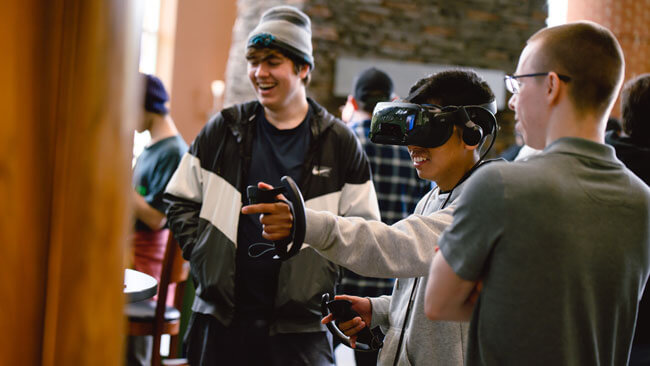
Like every Quinnipiac student, you'll have many opportunities to learn through hands-on experiences through research, course projects and capstones. These immersive opportunities not only demonstrate the depth of your knowledge and skills to professors and peers, but also make a strong impression on potential employers. By applying what you've learned in real-world contexts, you'll gain deeper insights into various industries and career paths.

Learn more about student work

Showcase Your Designs

Before graduating from the School of Computing & Engineering, every student is required to complete a Senior Design Project. This culmination of their time at Quinnipiac incorporates real clients and problems and simulates a project that they might encounter the first day on the job.

Projects Day

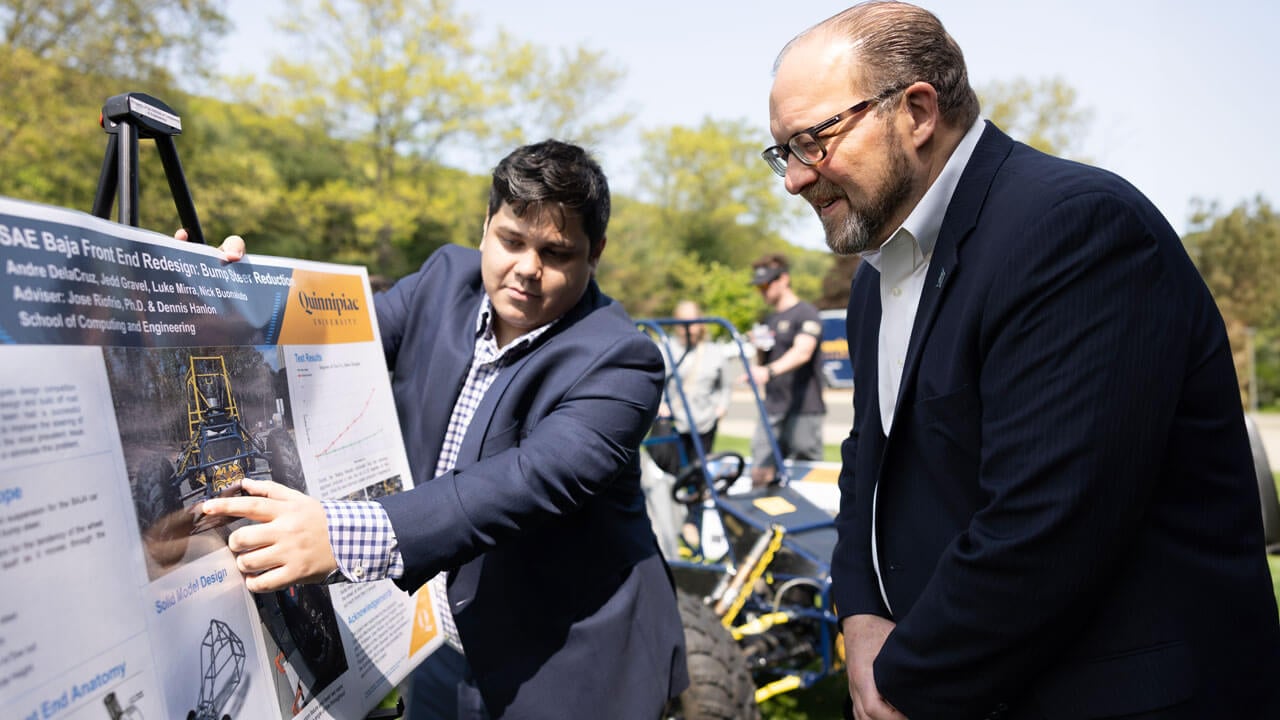
Projects Day is designed to showcase and celebrate our students’ hard work and achievements from real-world projects completed during the spring semester. Mentored by professionals in the industry, students assemble into design teams, choose topics and bring their ideas to life.

Learn more about Projects Day

Mechanical Engineering Projects

Based on the requirements of the ASME Waste Collector Challenge, the Department of Mechanical Engineering at Quinnipiac University seeks the design and development of a Quinnipiac-adapted, remotely operated, single-vehicle waste collection and segregation system. 

The system must be capable of navigating varied campus terrain and accessing multiple waste storage locations while efficiently collecting, transporting, and sorting materials into designated compartments. 

The device must operate safely without causing damage to property or infrastructure, comply with applicable operational and safety requirements, and maintain reliable remote-control functionality within the expected operational range.

Student Team Members: Tahira Jilu, Michael Gervais, Henry Wengel, Cynthia Skenderi, Erika Pinto 

Adviser(s): Cameron Lamack

Technician(s): Dennis Hanlon

Client: Quinnipiac University School of Computing & Engineering    

Tasked with the complete design, analysis, and assembly of a custom 4WD chain-driven drivetrain system, this project focuses on developing an integrated gearbox and differential solution for the Quinnipiac University Baja SAE team vehicle. The system will be engineered specifically for implementation in the team’s upcoming Baja SAE car, with careful consideration given to performance, durability, manufacturability, and serviceability under harsh off-road racing conditions.

Student Team Members: John Lindewirth, Chris George, Jorge Angulo, Nick Spence, and Carter Stevens

Adviser(s): Cameron Lamack

Technician(s): Dennis Hanlon

Clients: Baja SAE, Jose Riofrio 

Kinetic Communications is our senior capstone project focused on designing and developing a functional, motion-based communication system capable of producing American Sign Language (ASL). In collaboration with senior students from the School of Computing, the robot translates spoken input into precise movements that form accurate ASL signs in real time. Using a combination of servo motors, stepper motors, microcontrollers, and custom circuitry, the system replicates the motion of human shoulders, arms, and hands along with facial expressions displayed on the head to execute the complex movements required for clear and understandable signing.  

Our team is responsible for the complete engineering process, including the design and manufacture of major structural components such as the head, torso, shoulders, and upper and lower arms, as well as the development of custom motor control circuits and embedded systems. Throughout development, we emphasize reliability, repeatability, and accessibility. This project aims to improve accessibility and help bridge communication gaps for members of the Deaf and hard-of-hearing community.

Student Team Members: Kieran Boyle, Nicholas Farrell, Zachary O’Connell, Alexander Michel, Cade Wetter

Adviser(s): Cameron Lamack

Technician(s): Dennis Hanlon

Client: Dr. Chetan Jaiswal

Redesign a vehicle tray for ParkPlus’s AGV systems that address the need for improved cost and performance. The new tray significantly reduces overall weight and lowers manufacturing costs while simultaneously increasing shipping efficiency, shortening production lead times, and enhancing system reliability. Additionally, to achieve these objectives, the design incorporates an innovative process and uses fabrication methods that facilitate production in a timely and cost-effective manner. The prototype that our team, The Curbside Crew, produced has primarily serves the purpose of a proof of assembly and will be made on a one-fifth scale. The completed design solution must meet all structural and safety requirements, remain fully compatible with existing AGV operations, and be finalized and delivered to ParkPlus by May 8, 2026. Our primary contact is Jake Fitzpatrick, an engineer at ParkPlus.

Student Team Members: Kevin Murace, Charlyse LaMantia, Wilhelmina Kalish, Gabe Sousa, Alex Passaretti  

Adviser(s): John Reap  

Technician(s): Chad Hanebrink  

Client: ParkPlus (Primary Contact: Jake Fitzpatrick)

The problem addressed by the RC Garbage and Recycling Collector is the need for an efficient, compact, and maneuverable system capable of collecting and sorting waste within strict spatial and operational constraints compared to the ASME Student Design Competition requirements. The system must fit within a 50 cm × 50 cm × 50 cm bounding box while navigating narrow lanes and completing multiple waste-handling functions. Key challenges include minimizing total weight, maximizing energy efficiency, and designing a reliable lifting and sorting mechanism with sufficient range of motion. The truck must integrate a durable drivetrain, a controlled robotic arm or screw-drive lifting system, and a stable chassis that prevents tipping under load. The design must balance mechanical performance, manufacturability, cost, and competition scoring criteria.

Student Team Members: Emma Petersen, Andrew Sanz, Jack Cocca, Shayne Hasipi, Donato Cuzzolino 

Adviser(s): John Reap  

Technician(s): Dennis Hanlon 

Client: John Reap

The Seal Team 6.0 project is an automated gasket dispensing system designed for PTA Plastics in Oxford, CT. The device dispenses foam gaskets individually, removes the backing liner, and presents each gasket to an existing robotic automation cell. The system is built to handle two large and four small gasket sizes while maintaining high speed, accuracy, and gentle handling. Key constraints include reliable liner removal, OSHA and ISO safety compliance, compact bench top footprint, and durability for industrial use. The design incorporates dual conveyor belts, adjustable peel mechanisms, actuator driven loading systems, and Arduino based control with safety features including a kill switch. Modular subsystems allow iterative testing and refinement before full integration. The final design transitions from PLA prototypes to carbon fiber components for strength and long-term reliability.

Student Team Members:Andrew Miller, Oliver Hanson, Nicholas Ferreira, Zachary Kayton 

Adviser(s): Cameron Lamack  

Technician(s): Chad Hanebrink, Dennis Hanlon 

Client:PTA Plastics (Oxford, CT)

The objective is to design a support equipment mechanical system capable of loading and unloading cargo to and from a receiving vehicle.  The design must hand off weight from the support equipment to the vehicle while utilizing minimal attachment points.  The design minimizes the number of personnel needed to use the equipment, must be of minimum weight for transportation, and maintains clearance to the vehicle, the cargo, the personnel, and to the ground throughout its range of motion.

Student Team Members:Andre Boily, Colin Zemlanicky, Cynthia Staroscik, Grace Foley, Owen Korper

Adviser(s): John Reap 

Technician(s): Dennis Hanlon, Chad Hanebrink

Client:Sikorsky, a Lockheed Martin Company

Team’s project consists of the construction of a handheld stone launcher that achieves a consistent 5 skips along a body of water. On top of this, the launcher will be repeatable, launch the stone at a proper 20-degree angle, and achieve the proper velocity needed to complete the distance needed to achieve 5 skips.  The stones will be made by the team with natural clay.  The launcher will use a 270-degree torsion spring along with multiple parts such as an arm and shroud made from solid plastic and other materials.  The arm will be connected to the torsion spring, will latch back to another hook connected to a trigger. The user will then pull the trigger to launch the stone through the shroud.

Student Team Members: Sean O’Hagan, Jonathan McNulty, Andres Argueta

Adviser(s): John Reap 

Technician(s): Dennis Hanlon

Client:Jose Riofrio

The project is to design a means of testing the performance of different turbine blade configurations. The device needs to measure and record the power generated by a turbine during a measured release of water into the system. Replacement of the turbine must be simple and quick, as the device will be used by students in a QU SCE Lab setting. The frame is created from steel, and houses two water tanks, with PVC piping and valve allowing the water to flow down to the turbine and then is cycled back up to the top tank using pumps, producing values that can be used to determine which blade configuration is the most efficient.

Student Team Members: Rachel St. Germain, Matthew Sheehy, Marcus Peguero, Kyle DeRienzo, Riley Soybel

Adviser(s): John Reap

Technician(s): Chad Hanebrink

Client: John Reap

This project tasks our group with designing, building, and testing a remotely controlled waste and recycling collection device. The device must be compact, safe, reliable, and efficient while collecting and distinguishing between waste materials. The device should also be capable of real-time waste identification and sorting, be compliant with traffic laws and safety rules, operate within size/power restrictions, and serve as both a competition entry and a model for real-world urban waste challenges. The final design must fit within 0.125 cubic meter box with none of the dimensions exceeding 50cm across, deep, or high, be powered by safely housed dry-cell rechargeable batteries and be capable of operating under the competition's guidelines regarding navigation, sorting, safety, and efficiency.

Student Team Members: Shane Carter, Matthew Wordell, Ryan Santos, Nick Lorenzo, Simon Diaz

Adviser(s): Cameron Lamack

Technician(s): Chad Hanebrink, Dennis Hanlon

Client: Quinnipiac University Department of Mechanical and Industrial Engineering

Immerse yourself in funded summer research

Two students working with the School of Engineering's water flow simulator

Take part in the Interdisciplinary Program for Research and Scholarship

Open to students of all majors, QUIP-RS provides up to $5,000 in funding for undergraduate students to conduct research or complete creative projects alongside faculty mentors. This intensive 8-week program enables students to develop scholarly skills while encouraging discussion about successes and shortcomings with fellows and mentors.

Learn more about QUIP-RS

A Foundation for Your Future

100% Success Rate

Percentage of our 2025 program graduates who are either employed or pursuing graduate study six months after graduation (72.6% Knowledge Rate).

75% Hands-On Experience

Percentage of seniors who participated in at least one experiential learning opportunity during their time at Quinnipiac (75.7% Knowledge Rate).

Career-Building Resources

Job Market Trends

Quinnipiac students excel as interns, new hires, managers and executives in almost every industry. Gather real-world data about starting salaries, hiring trends and in-demand skills to inform your decision-making and put you on a path to success. 

Explore real-world data and insights

View all tools and resources

Design your career path

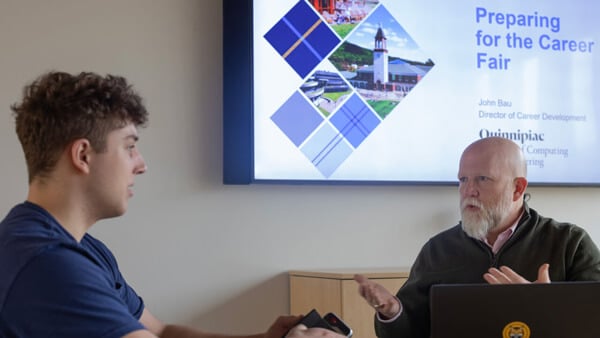
With an abundance of career-focused information and resources, the career advisers within the School of Computing & Engineering support students as they expand their professional networks and attract the attention of prestigious employers.

Learn more about career development

Career and Experiential Learning Lab

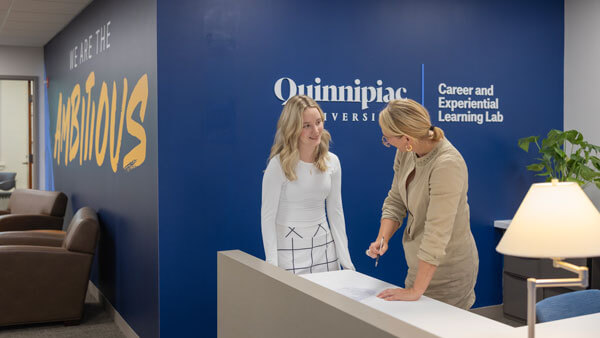
iQ, Quinnipiac University’s holistic approach to career development and experiential learning, surrounds every individual with a personalized plan that maximizes their time at Quinnipiac. The powerhouse of iQ, our Career and Experiential Learning Lab is the physical space where students and advisers bridge the gap between college and career. 

Learn more about our Career and Experiential Learning Lab