



Powerhouse pitches highlight student innovation at Spring Business Pitch Competition
April 21, 2026
April 21, 2026
Mostafa Analoui, director of the M&T Bank Center for Innovation and Entrepreneurship, said the annual competition spans the academic year and involves a multitude of student innovators. The journey begins with student workshops on the Mount Carmel and North Haven campuses in the fall. This year, 25 teams brought ideas forward, with 10 semifinalists, followed by five finalists, selected during fall 2025 Elevator Launchpad Pitch Competitions.
“It was a really tough decision,” Analoui said. “The ideas are all created by students. Our team provided some mentorship as well as support from faculty members, but the credit goes to the students who have created these ideas.”
Analoui said M&T Bank Center for Innovation and Entrepreneurship is committed to continuing to support all of the program’s student participants during their time at Quinnipiac and beyond, if they are committed to pursuing their ideas.
“One of the messages we gave to the 25 teams that started was that if you’re committed, it really doesn’t matter if you finish as number one or two. You’ve got 100 percent support from us. They will have our full support, moving forward,” said Analoui.
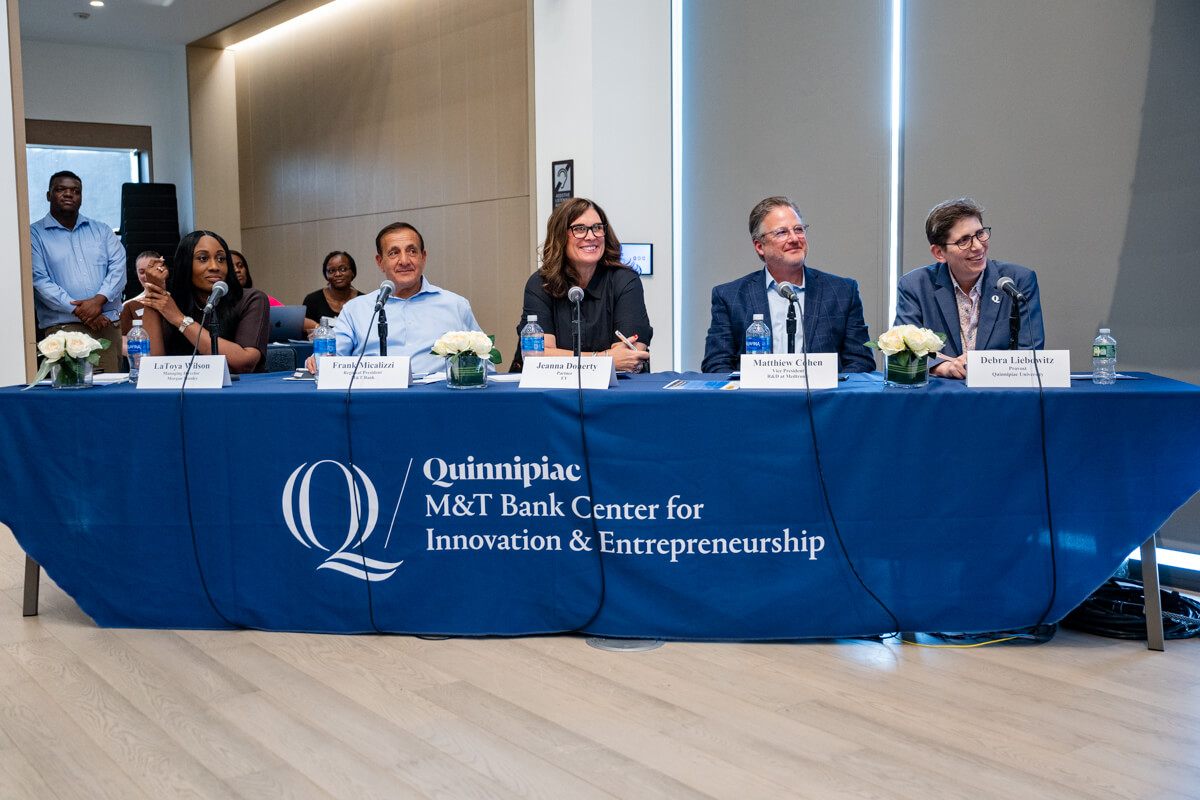
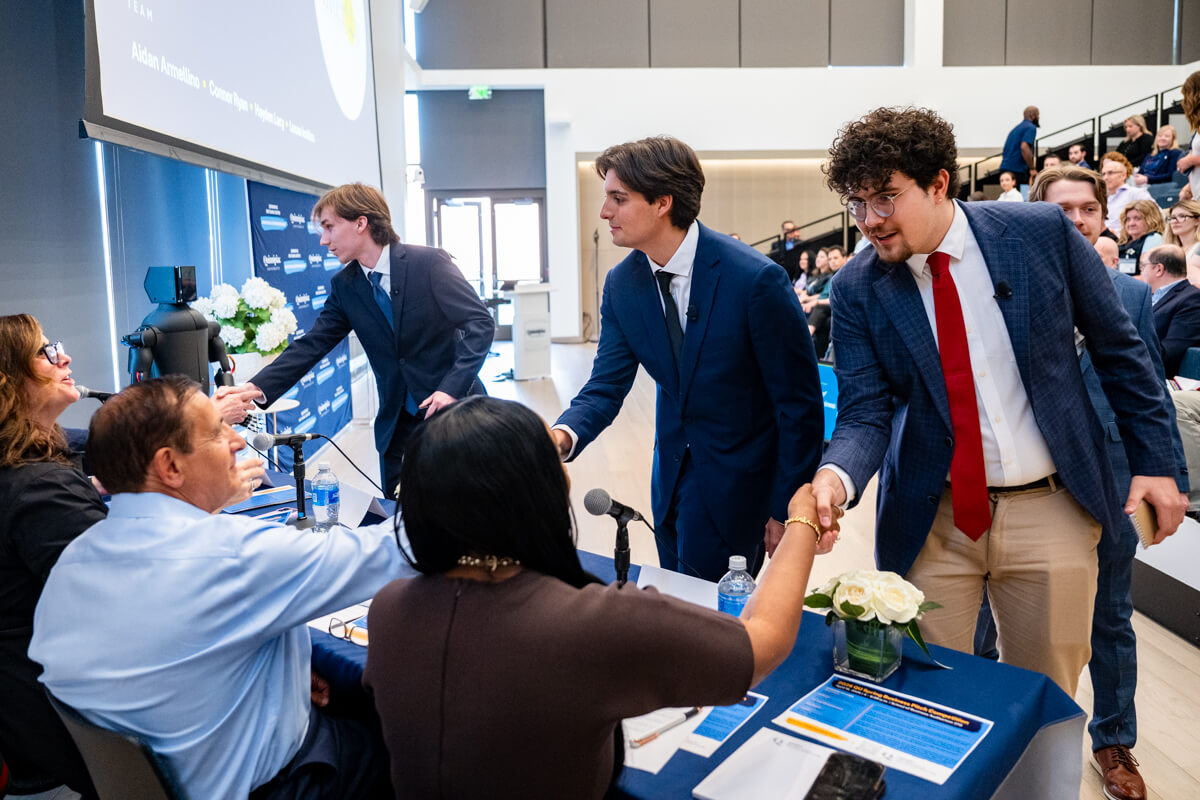
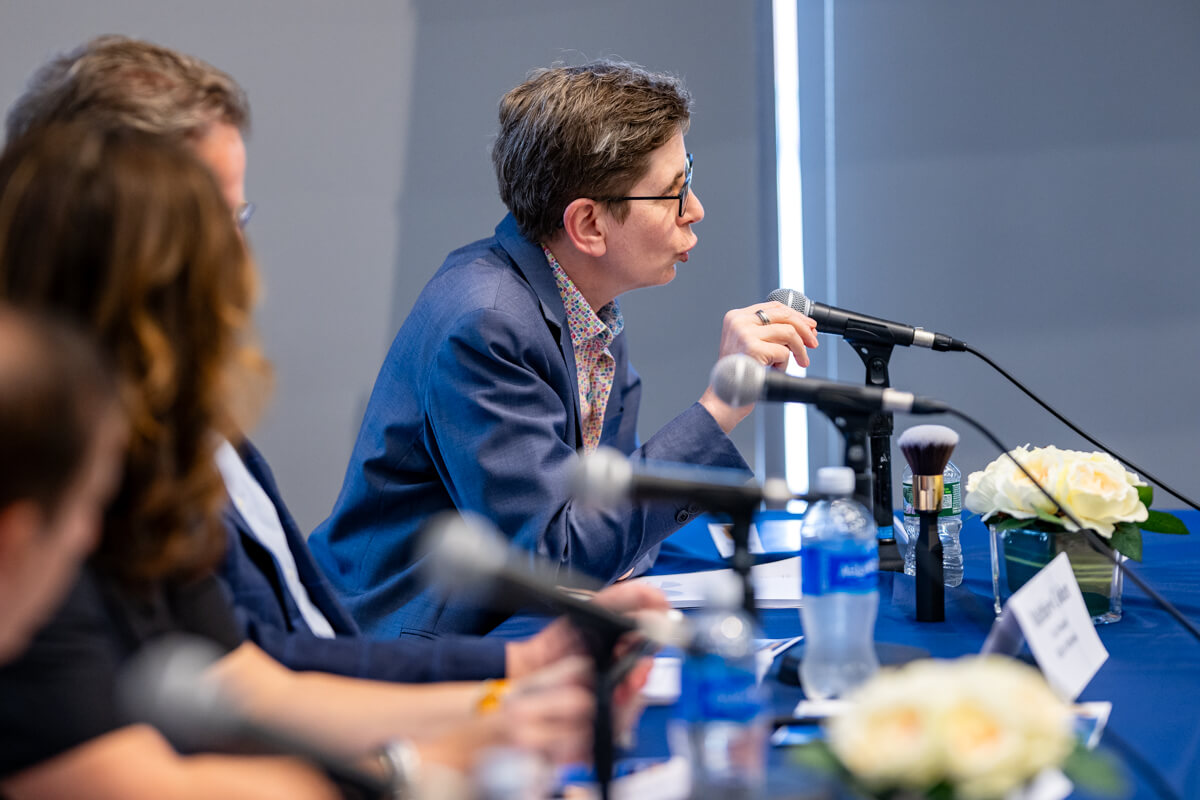
Quinnipiac 2026 Spring Business Pitch Competition judges were Medtronic Vice President of Research and Development Matthew Cohen; EY (Ernst & Young) Partner Jeanna Doherty; M&T Bank Regional President Frank Micalizzi; Morgan Stanley Managing Director LaToya Wilson; and Quinnipiac Provost Debra Liebowitz.
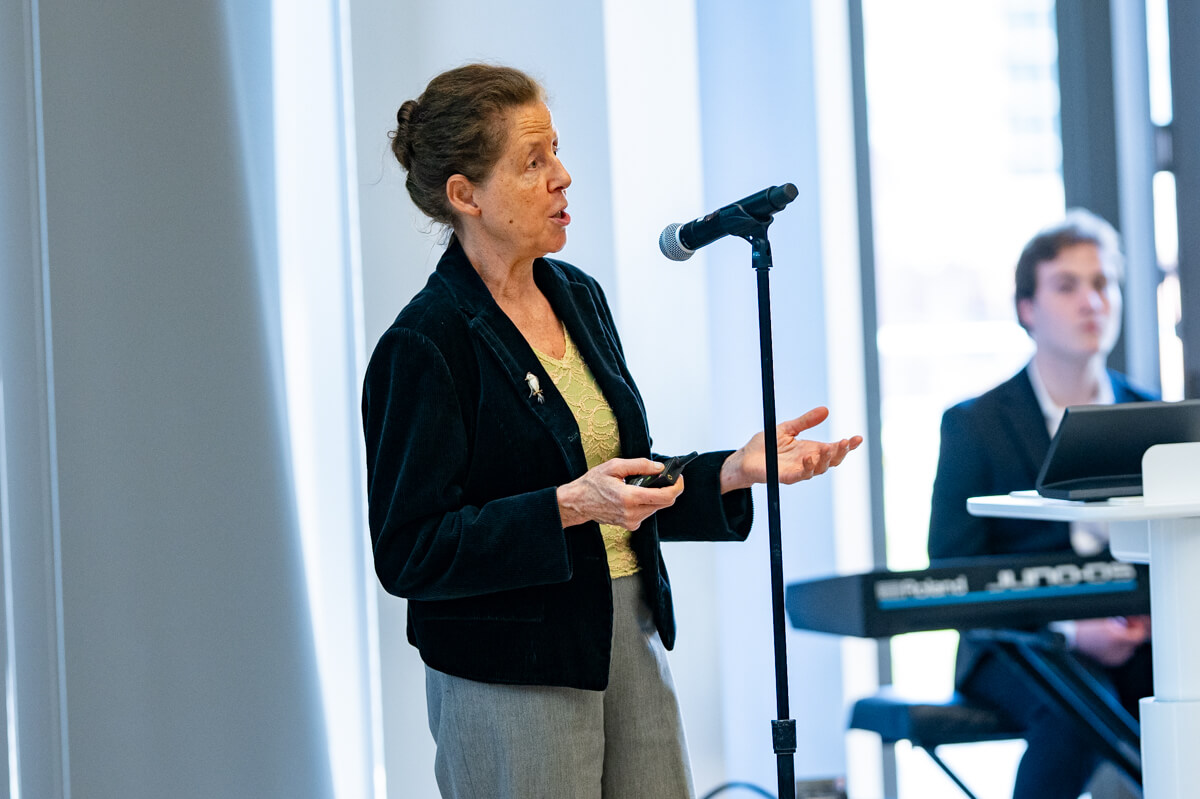
Quinnipiac Associate Professor of Entrepreneurship & Strategy David Tomczyk emceed the pitch competition. The event also featured a faculty highlight presentation by Professor Elena Bertozzi, Director for Game Design & Development at Quinnipiac University and SolitonZ Games cofounder. Bertozzi shared an inspiring elevator pitch describing SolitonZ Games work to improve healthcare communication to patients using game technology.
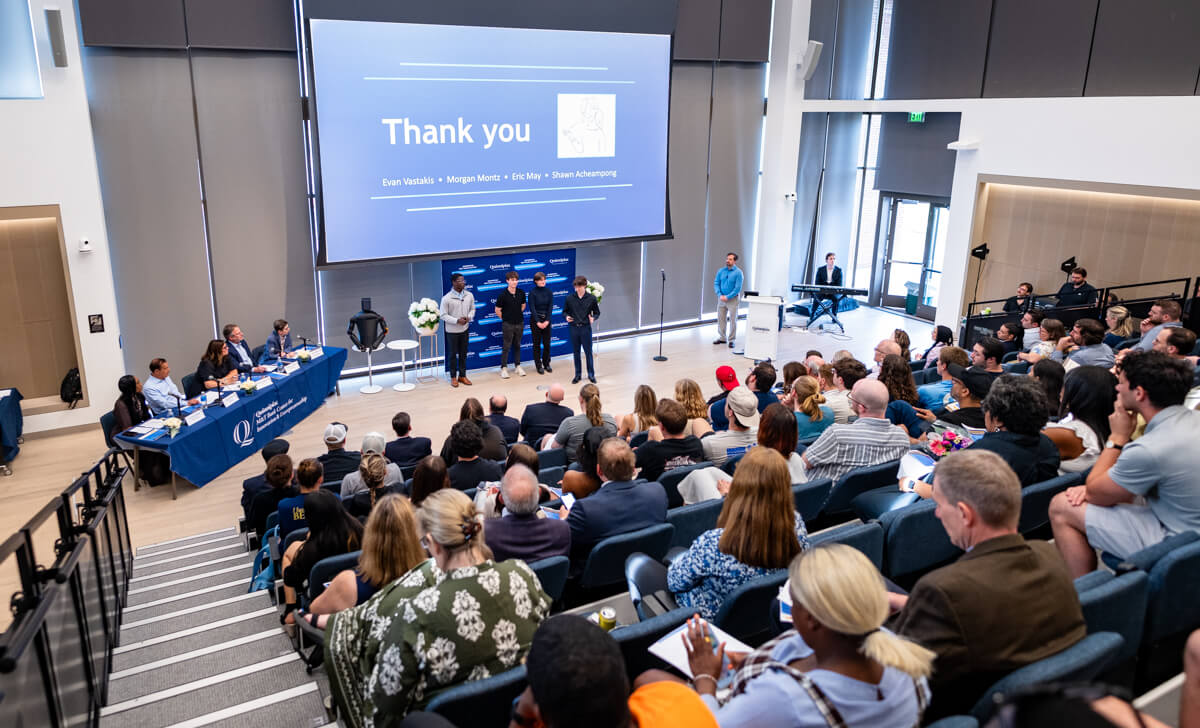
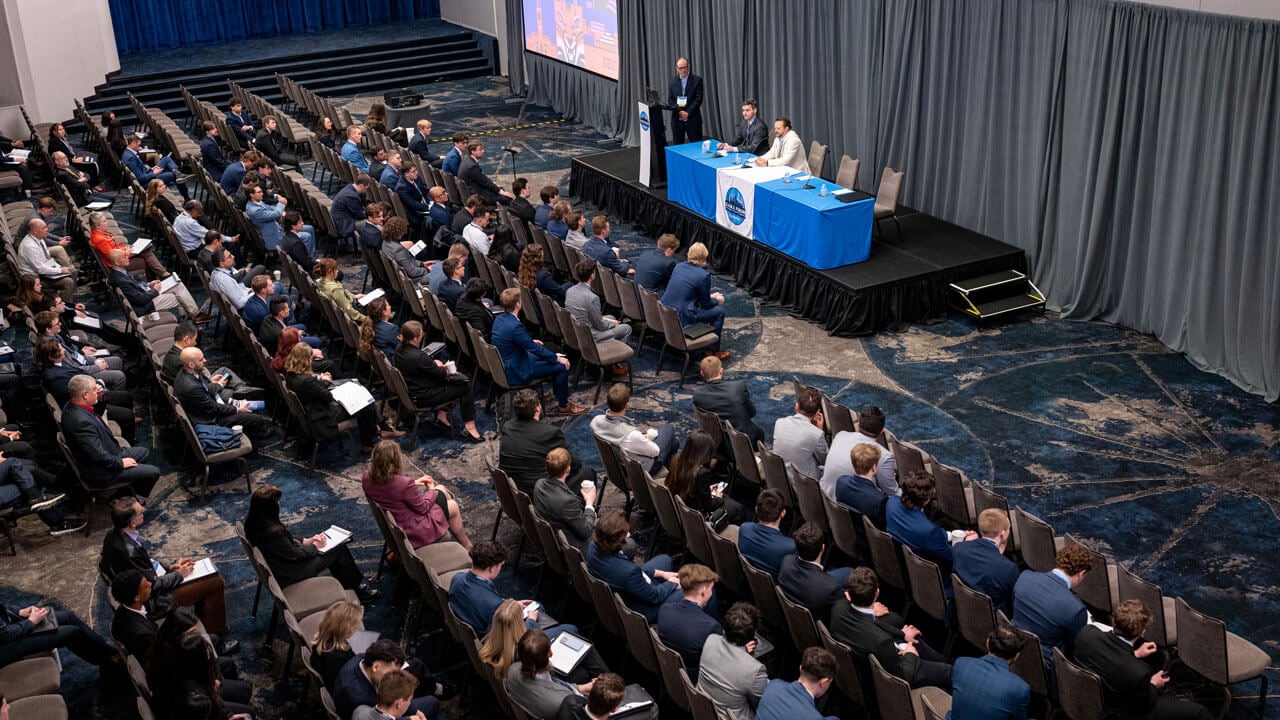
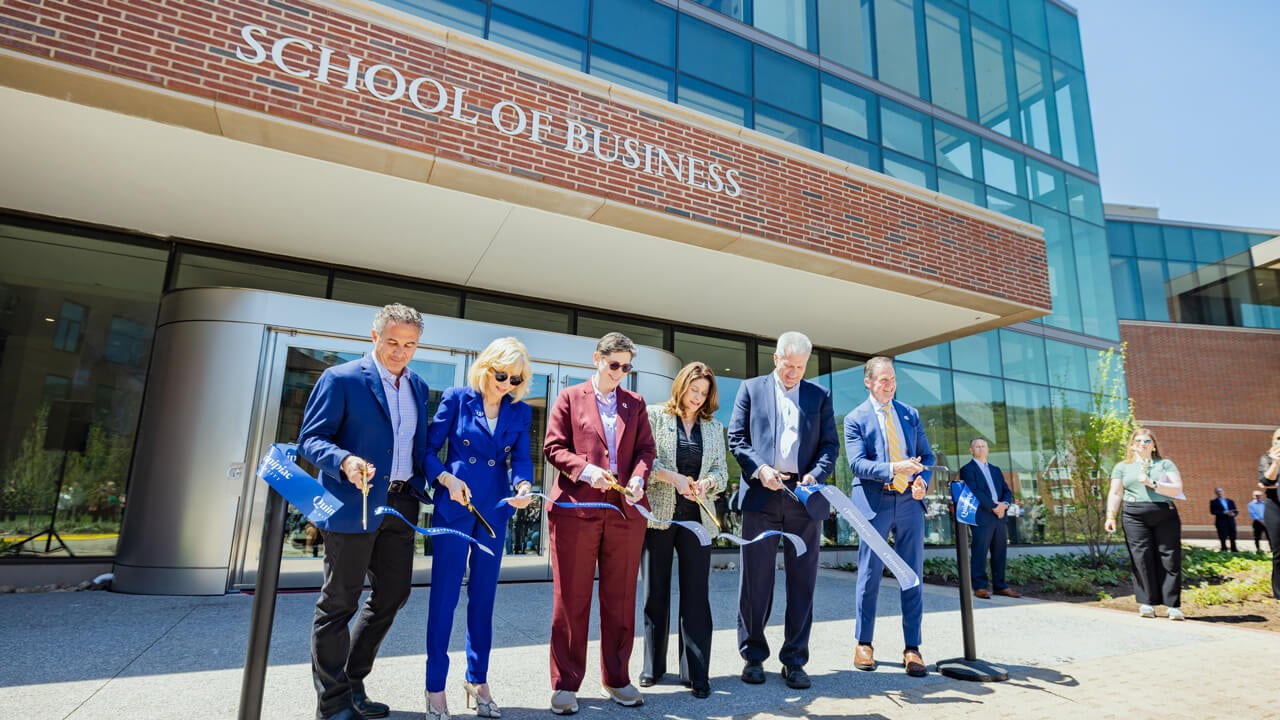
The April 16 event drew a high-energy audience to the School of Business auditorium. Analoui noted members of the Quinnipiac community were being joined by supportive executives from across the state, mentors who will help students move their ideas to the next stage, and student parents and families.
School of Business Dean Holly Raider thanked Analoui for his leadership and for working with students, staff, alumni and community volunteers in supporting Quinnipiac’s student entrepreneurs.
“Entrepreneurs and innovators go into the unknown. They step into and imagine what could be, by stepping into what isn’t,” Dean Raider said. “It is inspiring to see them embrace important problems to solve and generate potential solutions. As I look around the room, I could not be prouder to be part of a community of faculty, students, staff, alumni and community partners who are inspired by what could be and how we can make the world better.”
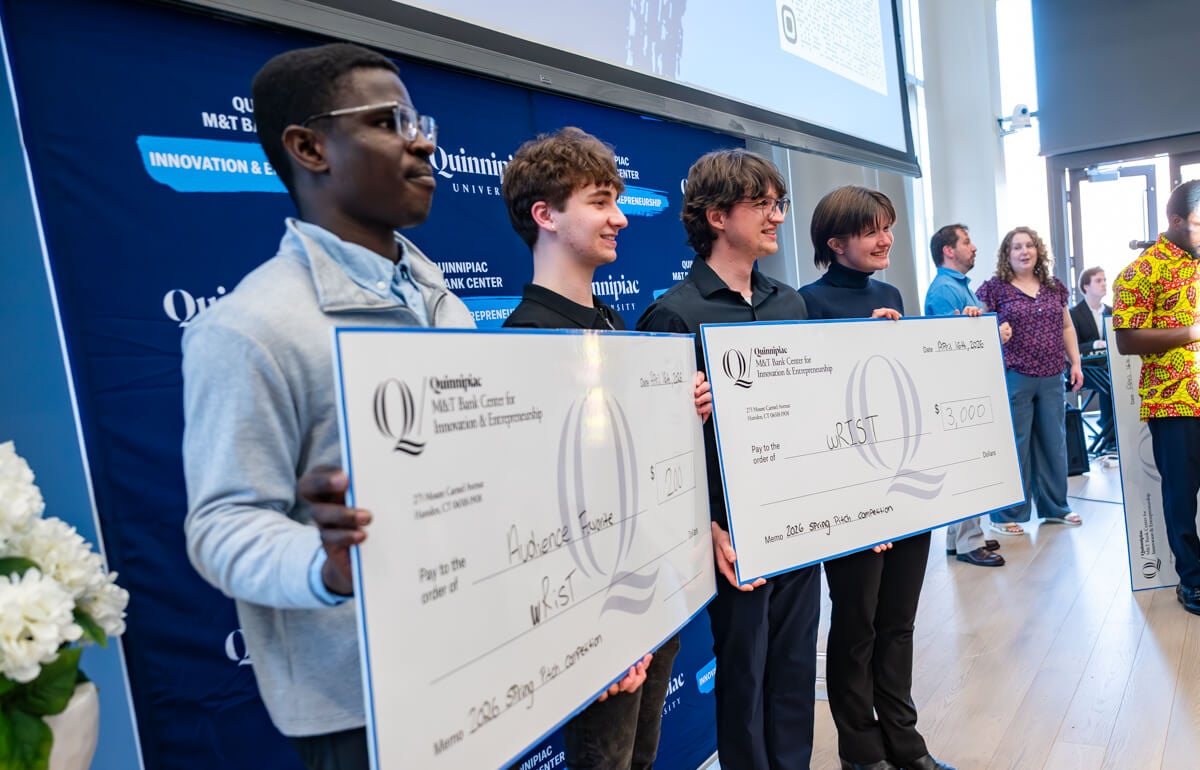
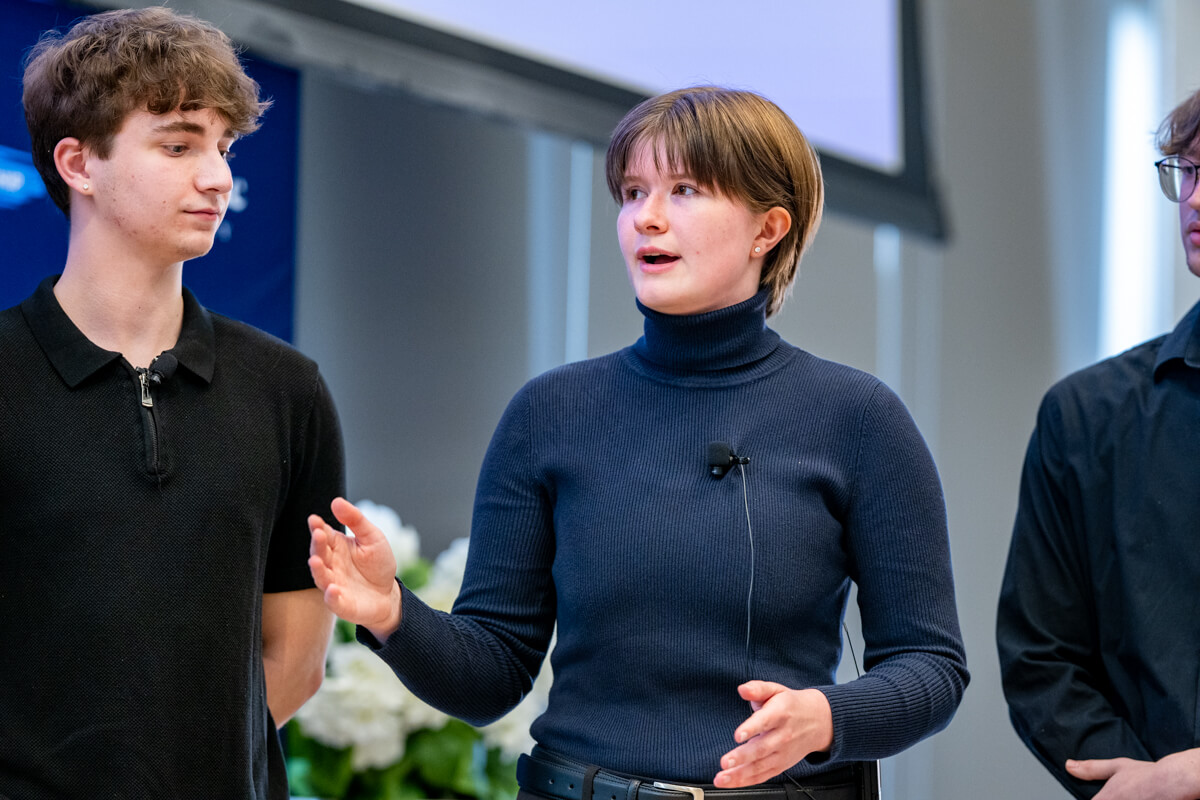
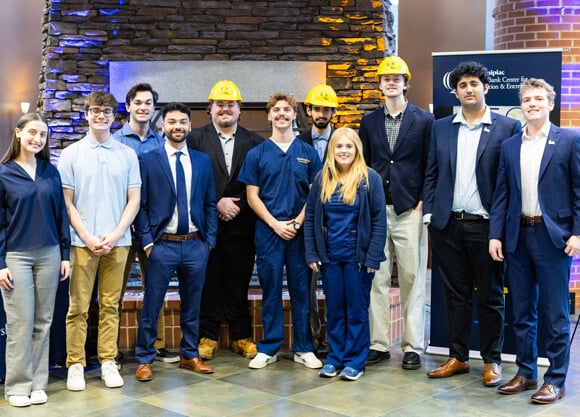
Following a fast five rounds of student pitches, judges awarded the contest’s top prize of $3,000 to wRIST, a robotic intermediate sign translator developed by an interdisciplinary team of computer science and mechanical engineering students. Also voted audience favorite, the wRIST team received an additional $200 prize.
Utilizing a fully functional, dual-arm robotic platform, wRIST uses American Sign Language (ASL) translation technology to transform spoken English into ASL hand gestures. wRIST operates in real time, with no human interpreter or internet connection required. The project is currently aligned with Hartford Healthcare for applications which could include hospital use.
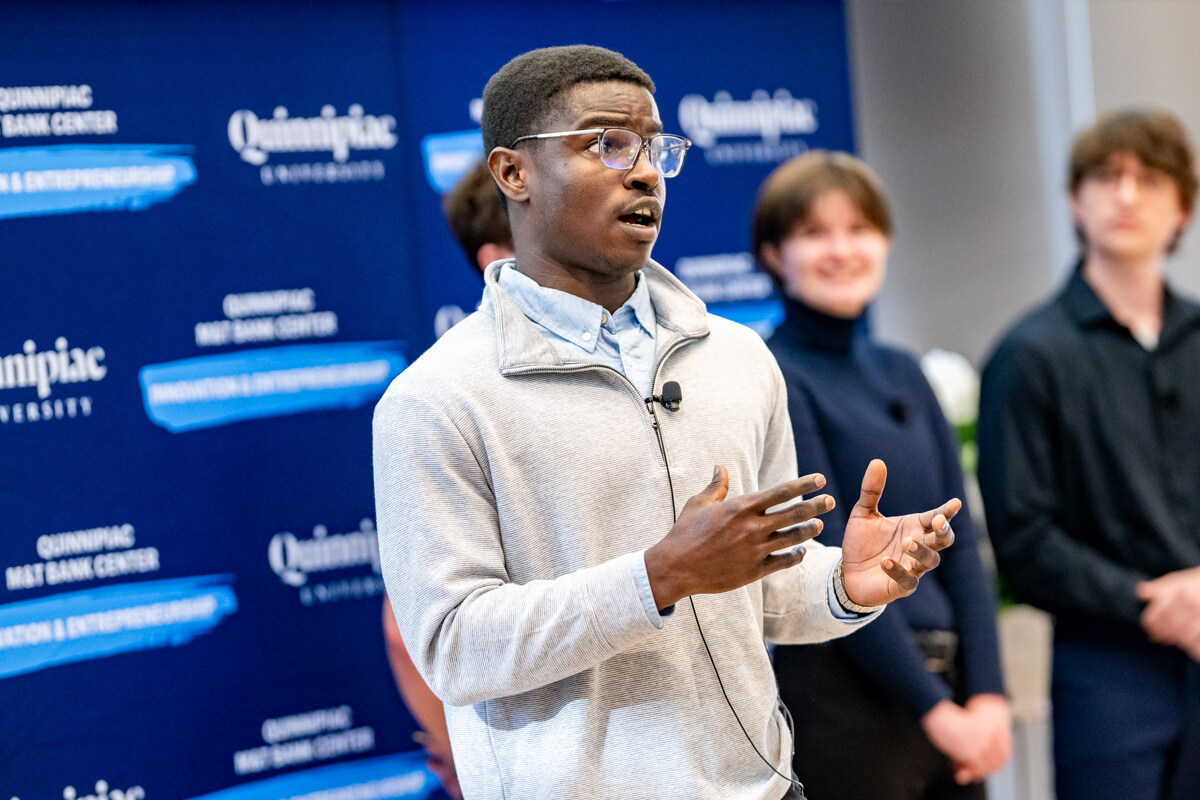
On April 16, the winning pitch for wRIST was made by computer science majors Eric May ’26, MS ’27; Shawn Acheampong ’26, MS ’27; Morgan Montz ’26, MS ’27; and Evan Vastakis ’26, MS ’27.
“All of the work we’ve put in this together, by two different, interdisciplinary teams is amazing,” Vastakis said. “I can’t thank them enough, and I can’t thank our team enough."
Just five days earlier, wRIST won first prize in the Computing App Development category at the Consortium for Computing Sciences in Colleges Northeast Region conference.
“This has been such an amazing project,” said Montz. “We poured so many hours into it and just knowing that this is going to be so helpful to so many people means so much to me.”
Associate Professor and Associate Chair of Computer Science Chetan Jaiswal advised wRIST and two other finalist teams at the spring pitch competition, InterQU and Eye Assist.
“You take a dream and give it one year and then it becomes reality,” Jaiswal said. “These ideas were started last year in the summer and early fall, and it took one year for them to get here. It’s hard to put into words how proud I am of them.”
InterQU earned second place and $2,000 award for its unique, real-time responsive AI-enhanced practice interview software. Team members are computer science majors Connor Ryan ’26; Lucas Jenkins ’26; Aidan Armellino ’26; and Hayden Lacey ‘26.
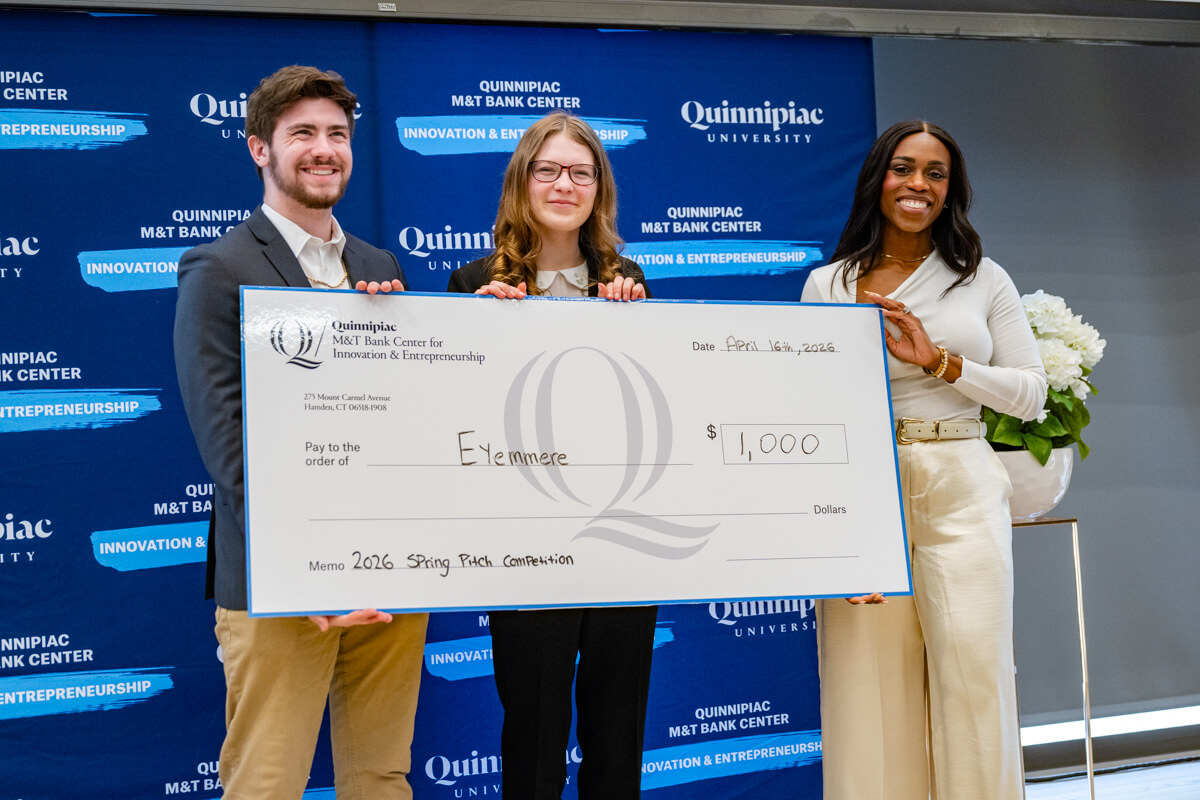
For creating an ergonomic, professional makeup tool that provides relief to professionals who work with their hands, Eyemmere founder Jody Ashielfie, ’25, MBA ’27, and her team of mechanical engineering majors Owen Culleton ’28; Zachary Chapman ‘27, MBA ’28; and Madelyn Peck ’28 earned third place and $1,000 award.
Awards of $500 were presented to 3D Fuel Measurement and Eye Assist. Developed by mechanical engineering majors Denes Lulo ‘27 and Austin Genter ‘27, 3D Fuel Measurement is an innovative marine technology venture which delivers precise, real-time fuel measurements by leveraging 3D technology. Eye Assist is the creation of computer science graduate student Nicholas Brown MS ‘26, who developed a real-time AI assistive navigation system for the visually impaired which bridges the gap between the digital and physical worlds.


















Quinnipiac Today is your source for what's happening throughout #BobcatNation. Sign up for our weekly email newsletter to be among the first to know about news, events and members of our Bobcat family who are making a positive difference in our world.
Sign Up Now