



Building the future of medicine with LEGOs
April 14, 2026
April 14, 2026
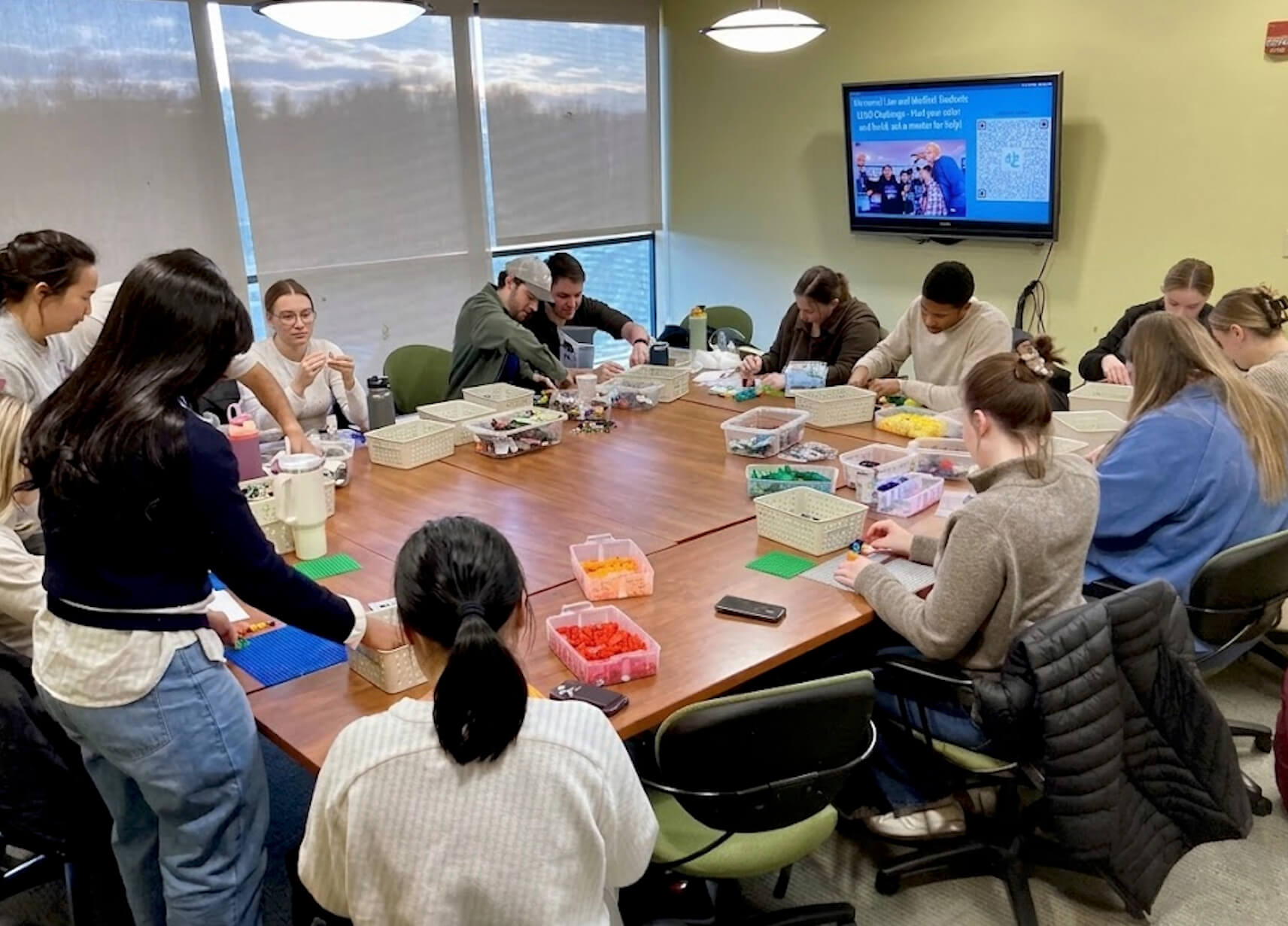
But this was not some playtime exercise from the past.
Instead, it was a novel teaching tool, a way for these students to connect with patients as part of a cancer survivorship course co-taught by Dr. Miklos Fogarasi, associate professor of medical sciences, and Dr. Cheryl Walters, a fellowship-trained internist specializing in difficult diagnoses.
“When we started (last) semester and asked students for their patient observations and reflections, it was basically radio silence,” Walters said. “But once they started building with the LEGOs, it was a huge icebreaker because it allowed them to work together. They could build with the LEGOs and write about their patients together. I was just amazed by how powerful this was.”
So were the students.
Several cancer survivors — honored guests, really — came to class to share their journeys. The students listened deeply and gratefully. Later, they scooped up handfuls of LEGOs to transform these stories into three-dimensional images of courage and grace.
Suddenly, a classroom became a space for humanity. Across a sprawling table, there were unconnected bridges, one side representing life before cancer, the other signaling life after cancer. At the other end of the table, there were LEGO kids in pretend hospital playrooms while their parents went for treatment.
For Alanna Tarabek, a second-year medical student, the exercise quickly clarified her purpose.
“The class itself was really transformative for me because we learned about the intricacies of oncology care and how it’s related to so many other specialties,” Tarabek said. “But the biggest impact was hearing from the survivors themselves. We had a number of survivors come in and speak to us in a very vulnerable way.”
And it was never taken for granted.
Fogarasi came to Quinnipiac Netter in 2015 after a 15-year career in hematology and oncology. He has taught the cancer survivorship course for the last 10 years, but this was the first time LEGOs were integrated into the curriculum.
Fogarasi is optimistic about the trajectory of cancer treatment, overall. The outcomes get better every year, every day. With about 18 million cancer survivors in America and growing, he said. Seeing cancer survivors for long-term follow-up is becoming the norm, not the anomaly, which is why teaching about cancer survivorship has made its way now into the curriculum of Quinnipiac Netter.
“We try to get the students comfortable with the complexities of cancer and with the idea that they will take care of patients who survive their cancer,” Fogarasi said. “Some of our patients are living long lives, even if they have active cancer. Some, fortunately, are cured. But there’s still a large physical, social, spiritual and psychological toll they pay.”
While meeting cancer patients and seeing them beyond a diagnosis takes time, LEGOs help students build the skills to connect with patients through shared goals and a shared vision.
For Sarah-Grace Gaston, a graduate student in the School of Health Sciences, building these cancer stories with her peers was both unique and insightful.
“It was interesting to see into the minds of the other students. They could read the same passage or the same prompt as me and have a very different interpretation,” Gaston said. “It would come out in what everyone built with the LEGOs.
“The first time I was like, ‘I’m not really sure what to build, or is this even enough?’ But after the second or third time, I learned to love building with the LEGOs,” she added. “I initially treated it like an assignment, but really, it was just another way to visualize and to see inside the minds of others.”
Walters and Fogarasi understood the students needed to learn how to communicate more effectively — with each other, of course, but also with their patients.
“Along the way with the students, they figured out that patient communication is extremely important,” Walters said, smiling. “Not only for clues to help you make diagnoses, but also for the best treatment to get the best outcomes.
“You need to have a deep appreciation for a patient's story. We’re always looking for the patient's perspective on what's happening. We’re looking for their values,” Walters said. “What kinds of goals do they have? Are they more interested in function being continued, or are they more interested in longevity? These are all important questions. The students are learning how to help patients answer them.”
Besides a great exercise in communicative and reflective skills, this is scholarly work as well. Fogarasi and three participating students are writing a paper on the experience of teaching with LEGOs as a new visual thinking tool and they are proud to have their abstract on the topic accepted for the American Society of Clinical Oncology meeting in Chicago this June, the largest international conference on cancer in the United States.












Quinnipiac Today is your source for what's happening throughout #BobcatNation. Sign up for our weekly email newsletter to be among the first to know about news, events and members of our Bobcat family who are making a positive difference in our world.
Sign Up Now