

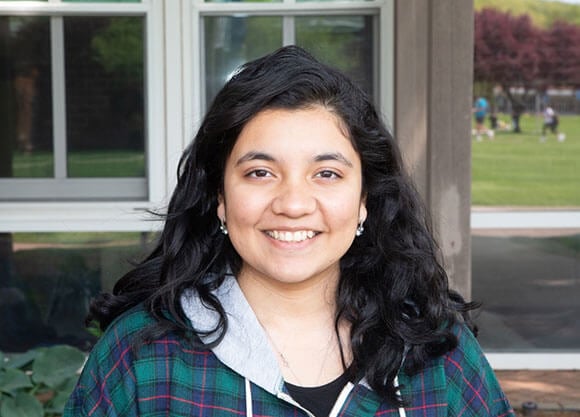

In her doctoral work, Lisa A. E. Kaplan, Ph.D. established the existence of Cytochrome P450pj in fish and documented the impact of nitrosodialkylamines on liver necrosis. As a post-doctoral fellow at NYU Medical Center, she studied the impact of heavy metal toxicity and oncogene activation in fishes.
Dr. Kaplan's current research focuses on the relationship between plasticizer exposure and altered crayfish aggression, fish social behaviors, and amphipod locomotion. Since these behaviors are influenced by serotonin (aggression, locomotion, cognition), and dopamine (movement, emotion, motivation), she evaluates these neurotransmitters to determine how exposure to plasticizers potentially disrupts behavior.
Students actively involved in Dr. Kaplan's research learn to appreciate the whole organism down to the molecular level, explore different approaches to a problem, view information from different disciplinary angles, and synthesize more comprehensive explanations.
Dr. Kaplan's main goal as a teacher is to facilitate learning with understanding, good judgment, and experience in a way that all members of the class find accessible, exciting, and even compelling. Under every circumstance, she strives to gradually, and, justifiably, build student confidence, independence, and self-discipline as they move from development of declarative/procedural memory to a deeper, more powerful understanding that results in synthesize and application of knowledge.
Dr. Kaplan's current research focuses on the relationship between plasticizer exposure and altered crayfish aggression, fish social behaviors, and amphipod locomotion. Since these behaviors are influenced by serotonin (aggression, locomotion, cognition), and dopamine (movement, emotion, motivation), she evaluates these neurotransmitters to determine how exposure to plasticizers potentially disrupts behavior.
Students actively involved in Dr. Kaplan's research learn to appreciate the whole organism down to the molecular level, explore different approaches to a problem, view information from different disciplinary angles, and synthesize more comprehensive explanations.
Dr. Kaplan's main goal as a teacher is to facilitate learning with understanding, good judgment, and experience in a way that all members of the class find accessible, exciting, and even compelling. Under every circumstance, she strives to gradually, and, justifiably, build student confidence, independence, and self-discipline as they move from development of declarative/procedural memory to a deeper, more powerful understanding that results in synthesize and application of knowledge.
Education
- BS, University of Connecticut
- MS, University of Connecticut
- PHD, University of Connecticut
Organization
- Biological Sciences
Office Location
- The Site 174
Mail Drop
- SI-TE1
Courses
-
BIO 208 Introduction to Forensic Science
Spring 2027 -
BIO 208L Introduction to Forensic Science Lab Science Laboratory
Spring 2027 -
BIO 211 Human Anatomy and Physiology I
Fall 2026 -
BIO 212 Human Anatomy and Physiology II
Spring 2027 -
BIO 221 Plastics - Miracle Or Curse?
Spring 2027 -
BIO 250 Biology Journal Club
Fall 2026 -
BIO 491 Independent Research in Biological Science
Fall 2026 -
BIO 492 Independent Research in Biological Sciences
Fall 2026 -
BIO 493 Independent Research in Biological Sciences
Fall 2026 -
BMS 651 Thesis II
Fall 2026 -
BMS 688 Independent Study
Summer 2 2026 -
CAS 420 CAS Integrative Capstone
Fall 2026 -
ENV 223 Plastics - Miracle Or Curse?
January Term 2027 -
FS 120 DNA in Forensic Science
Fall 2026
Quinnipiac Today