



Quinnipiac Law’s BLSA Thurgood Marshall Award ceremony honors three outstanding individuals
April 06, 2026
April 06, 2026
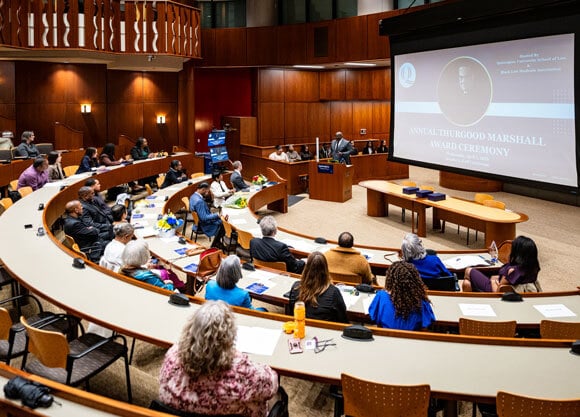
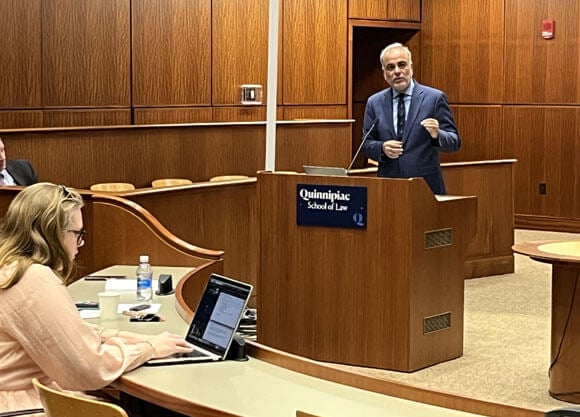
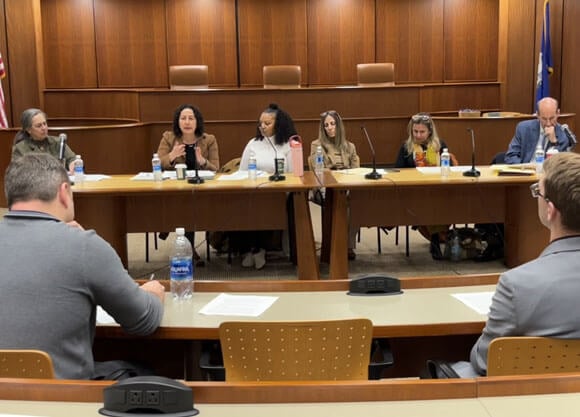
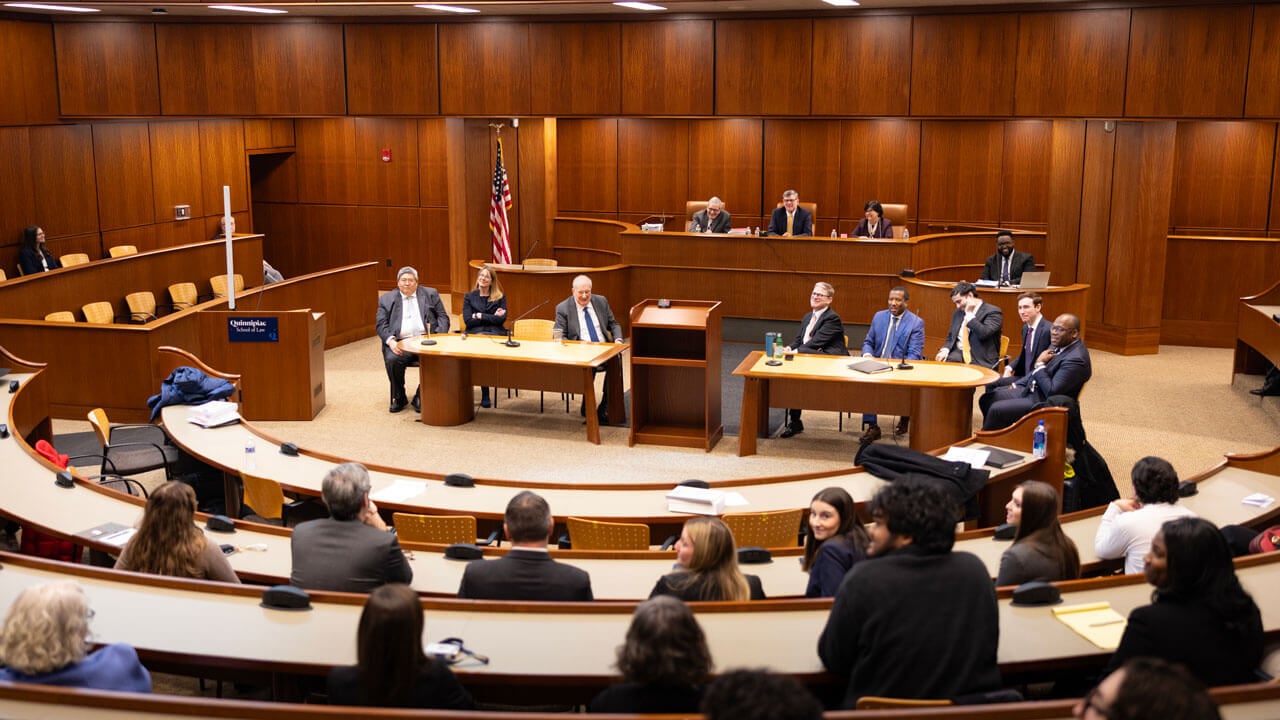
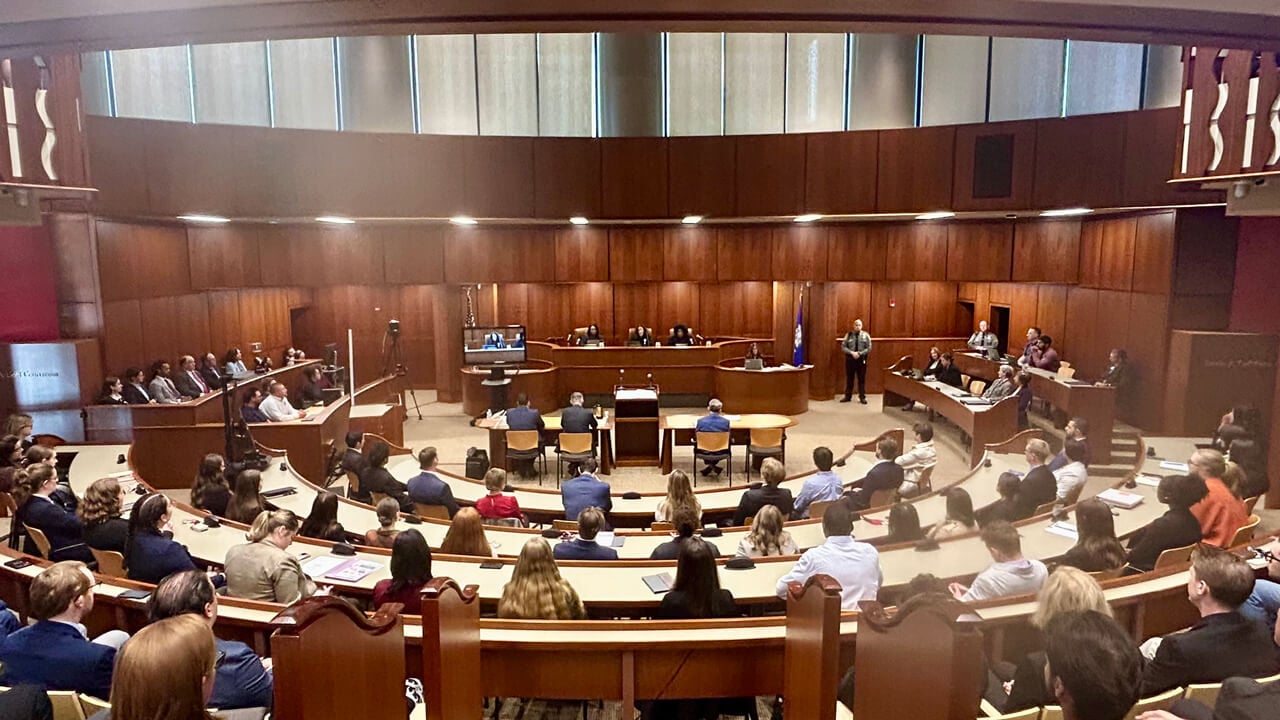
The powerful annual event honors the social justice advancements and impactful legacy of Justice Thurgood Marshall, the first Black American to be appointed to the U.S. Supreme Court. The April 1 ceremony in the law school’s Brooke A. Goff Courtroom honored Thurgood Marshall Award recipient Judge Dawne G. Westbrook and Community Service Award recipients Carroll E. Brown and Dwayne Smith.
The night was a celebration of purpose, perseverance and the power of service, said Deja Seawright, JD ’26, BLSA president.
“The Thurgood Marshall Award and the Community Service Award continue a tradition that we uphold proudly each year,” said Seawright. “Justice Marshall’s legacy is one of courage, advocacy and unwavering commitment to justice. In that spirit, this award recognizes an individual within the community whose work advances civil rights, civil liberties and human dignity. This evening we are deeply honored to recognize the Hon. Judge Dawne G. Westbrook for her exemplary leadership, her dedication to the law and her continued commitment to advancing justice.”
Seawright said the Community Service Award honors those whose compassion in service creates meaningful change as they lead with purpose and uphold those around them.
“This year we are especially proud to recognize not one, but two outstanding leaders. Their work represents the very essence of service, and their impact is felt far beyond the communities they directly serve,” Seawright said.
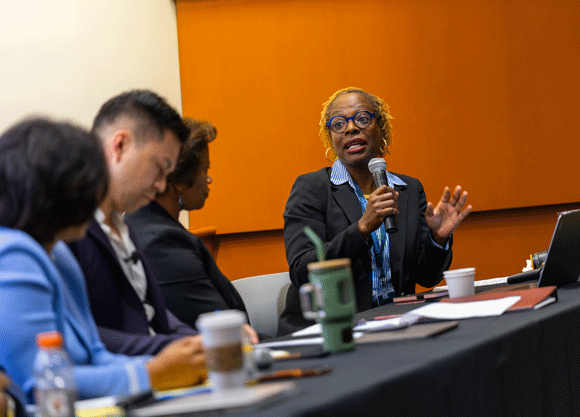
BLSA members and the law school community joined the audience in recognizing the guidance and support of founding law school faculty and long-standing BLSA adviser Marilyn J. Ford, professor of law.
Ford thanked the many supporters of the annual BLSA program. She also recognized Seawright, BLSA immediate past president Ishtar Edwards, JD ’26, and all BLSA officers and members for the effort invested producing the annual event.
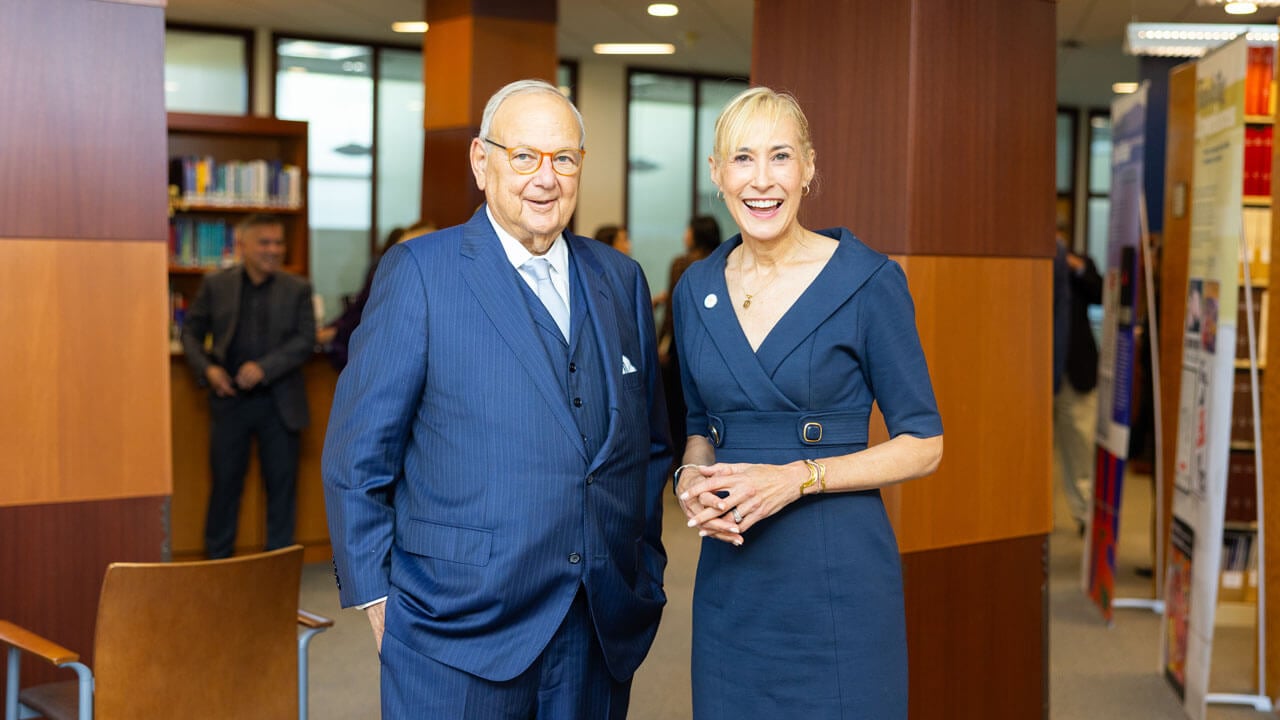
Brian Gallini, dean of the School of Law, thanked Ford and BLSA for an important program which honors the towering legacy of Thurgood Marshall. He said Justice Marshall’s work fundamentally transformed American jurisprudence.
“Before becoming the first African American Justice of the U.S. Supreme Court, Justice Marshall was a brilliant legal strategist who understood the law as a tool for dismantling injustice and expanding opportunity. His leadership in Brown v. Board of Education helped to dismantle the doctrine of ‘separate but equal’ and began the long, and unfinished work of giving real meaning to America’s promise of equal justice under the law,” Dean Gallini said.
“His legacy challenges each generation to use the law not simply to interpret society as it is, but to help shape it into something better. And tonight, we honor individuals who have answered that challenge,” said Dean Gallini.
The Hon. Dawne G. Westbrook’s distinguished career in public service has demonstrated a commitment to steadfast fairness, equity and the rule of law. From advocating for civil rights, to her service on the Connecticut Superior Court and now the Appellate Court, she has embodied the values the Thurgood Marshall Award represents.
“Her leadership within the judiciary, dedication to education and mentorship, and her deep engagement with the community reflect a lifetime commitment to justice in action very much in the spirit of Justice Marshall’s legacy,” Dean Gallini said.
Judge Westbrook’s legal career began with the Connecticut Commission on Human Rights and Opportunities, followed by joining a law practice, then establishing her own practice focusing on civil rights, constitutional rights, employment discrimination, juvenile law, and criminal law. Appointed to the Connecticut Superior Court in 2009, Judge Westbrook was elevated to the Connecticut Appellate Court in 2023. She has held leadership roles in the branch, including Chief Administrative Judge of Juvenile Matters and Administrative Judge of the Tolland Judicial District. Her service also includes her contributions as a member of numerous branch and executive branch committees.
As an educator, Judge Westbrook teaches juvenile law as an adjunct professor at University of Connecticut Law School. She serves as a mentor through her work and through the Lawyers Collaborative for Diversity.
Judge Westbrook earned her JD from Vanderbilt University School of Law, where she was a BLSA member. She was awarded a National Nelson Mandela Scholarship and named a Council on Legal Education Opportunity Fellow.
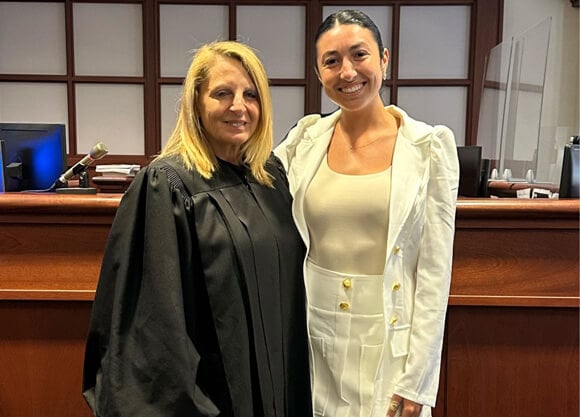
The Thurgood Marshall Award was presented by BLSA secretary Kimberly Guerrero, JD ’27. Judge Westbrook thanked the law school and BLSA for recognizing her contributions to the legal field.
“To receive an honor in the name of Thurgood Marshall is extremely meaningful, but what makes this recognition even more meaningful is that it comes from you, the students,” said Judge Westbrook. “You are not only studying the law, but you are deciding what role you will play in the law. And what Marshall’s life reminds us of is the Constitution has never enforced itself. It is always dependent on people willing to insist that it be honored. But also, I think of something more personal when I think of Justice Marshall, but just as important. He taught us, and he understood, what it meant to enter rooms and institutions that were not designed for him in mind. And he entered them anyway.”
Judge Westbrook said much of her early career was dedicated to representing those who were overlooked, underestimated or treated as disposable.
“That work taught me something fundamental. The law is not inherently just. It becomes just only when those who practice it insist that it reflects our shared humanity; when we make sure that those affected by the law are seen, heard and recognized as fully human,” said Judge Westbrook.
She challenged BLSA members to contribute their talents and tenacity to their profession. She also encouraged the law students to recognize the example they were setting, often without knowing, for those who will come after them.
“I encourage you to speak, even when its uncomfortable; apply, even if you are uncertain of your chances; and continue to show up. The goal is not just to enter the profession; it is to make it better. To make it more just, responsive, and reflective of the communities it serves and to make it easier for the next person to walk into those spaces and know that they belong. That is how we honor the legacy of Thurgood Marshall,” Judge Westbrook said.
To honor lives invested in service, leadership and an unwavering commitment to uplifting others, the BLSA Community Service Award was presented to Brown and Smith by Mariama Diallo, JD ‘27, BLSA communications chair; and Tianni Dicks, JD ’27, BLSA treasurer.
Brown’s decades of advocacy, civil engagement and community leadership have left an indelible mark across West Haven and beyond. Born in Fort Worth, Texas, Brown grew up in Seattle, Washington, serving as NAACP Youth Council president at age 14. With the support of a high school which fostered her talents and encouraged her to aggressively pursue her purpose, Brown went on to major in voice and choral conducting at Seattle University, and began career as a community organizer, singer and model.
Brown is proud to note she met her late husband, Teddy Brown Sr., on a blind date 68 years ago. Brown said receiving the Thurgood Marshall Community Service Award on her late husband’s birthday was especially moving.
Throughout her adult life, Brown has been deeply involved as a civil rights activist. She marched with the late Rev. Jesse Jackson, union leaders, Rev. Edwin R. Edmonds, New Haven clergy, and many other civil rights leaders. In West Haven, she served as the first African American president of the West Haven PTA Council, president of three school PTA’s, was elected to the West Haven Board of Education, serving as vice president. As former executive director and CEO of the Greater Waterbury Interfaith Ministries, Brown fostered numerous innovative programs supplying community members with basic needs and vital assistance.
“As an organizer, an activist, a mentor, a tireless voice for justice, she has worked across faith communities, schools, public institutions and grassroots organizations to confront inequity and to strengthen opportunity. Her work reminds us that meaningful change often begins close to home and sustained commitment can transform entire communities,” Dean Gallini said.
Brown’s contributions in New Haven County and beyond have earned her numerous accolades and recognition awards, including the Martin Luther King Jr. Award presented by the Greater New Haven NAACP, the Distinguished Citizens Award from the West Haven Black Coalition and the Benjamin L. Hooks Outstanding Leadership Award from the Connecticut State NAACP.
“I am truly honored and deeply humbled to receive the Thurgood Marshall Community Service Award,” Brown said. “To be recognized in the spirit of a man who stood so firmly for justice, equality and dignity for all people is something that I do not take lightly.”
Brown said her life’s journey has been shaped by faith, family and perseverance. The profound loss of her mother, who died in childbirth was Brown was six, introduced Brown to the strength of family. Among those who helped raise her were aunts who were both educators and musicians. They instilled in Brown a love for learning, discipline and grace.
She said their encouragement helped her to grow up with a voice, both literally and figuratively, during a time of blatant injustice.
“I grew up in Portland, where I knew what Black and white was all about. Signs everywhere — the toilets said Colored. The fountains said Colored,” Brown said. “Going to the back of the bus, 8 years old, I said, ‘Why do I have to go to the back of the bus? I’m not going to the back of the bus.’ And I didn’t. I went to my piano lessons every week and I sat behind the bus driver or across from the bus driver. That little bit of aggression that I saw in my aunts taught me to stand up for what I believe in. Stand up for what is right,” Brown said.
Brown said her motto of more than 50 years has been, “In unity there is strength, together we stand, divided we fall.”
“Let us all continue to preserve this country and take care of our youth. If you sit on any national boards, make your drive be for our youth,” Brown asked of the audience. “I work in the community not to be paid, not to be rewarded with plaques. I do it because I love the community, and I want the community to always be equal.”
Smith’s career in higher education reflects a profound belief in the transformative power of education, Dean Gallini said.
“As an academic leader, an administrator, an advocate for access and student success, he’s helped expand pathways for countless students across Connecticut and the nation. His leadership has strengthened institutions, has opened doors for first-generation and underrepresented students, and reinforced the idea that education is one of the most powerful engines of social mobility and justice that we possess,” said Dean Gallini.
With more than 40 years of progressive leadership experience in higher education as an administrator and faculty member, Smith currently serves as the executive director of Systemwide Advancement for the Connecticut State Colleges and Universities.
Prior to his current role, Smith served as the interim president of Southern Connecticut State University (SCSU). Under his leadership, SCSU achieved Carnegie Research II status and became a national leader in producing Fulbright Scholars. During his tenure, SCSU experienced sustained increased enrollment, enhanced philanthropic giving and established significant partnerships and collaboration.
“When I was the interim president at Southern Connecticut State University, we had a big vision on transforming the institution, and the one moniker that we had is, ‘everything is possible.’ And throughout my life that has really been my rallying cry. Through the ups and the downs, everything is possible,” said Smith.
Smith joined SCSU after serving as CEO of Housatonic Community College, where he established over 20 strategic collaborations and partnerships. The college also received its largest private gift, $1 million, founding the Peter Werth Entrepreneurship and Innovation Center. Under Smith’s leadership, Housatonic was also awarded a $1 million U.S. National Science Foundation (NSF) grant and an additional $1 million from the U.S. Department of Education to expand the institution’s Advanced Manufacturing Technology Center.
Among additional higher education roles in his distinguished academic leadership career, Smith served as provost and interim president of Harris-Stowe State University (HSSU) in St. Louis, Missouri. He successfully led the public historically Black university through six major accreditations and secured a $10 million NSF grant, the largest in HSSU history.
Under his leadership, HSSU’s comprehensive growth strategy expanded its degree offerings by more than 75%, established new undergraduate opportunities, added STEM degrees, and increased yearly degree production by over 40%.
Smith’s career is marked by service on numerous boards and recognition through awards such as the Chair Academy International Exemplary Leadership Award, One Hundred Influential Men of Color in Connecticut, Deluxe Magazine St. Louis Power 100, and Truman State University Distinguished Service Alumni Award.
As the grandson of Mississippi sharecroppers, Smith said he draws from his family’s history to underscore his belief in the transformative power of education and to emphasize that higher education can alter the socioeconomic paths of individuals.
“I grew up very impoverished. My mother was one of 10 who sharecropped the land. My mother was a brilliant woman, and it was because of the conditions of the Mississippi Delta that she did not reach her full promise. But she was able to produce seven children with over 10 college degrees,” said Smith. “We can trace our lineage back to 1820 in this country. My brother was the first Smith in 150 years to earn a college degree. I was the first Smith in 180 years to earn a Ph.D. It’s not because I was the smartest Smith. It was because I had opportunity and access. They call me Dr. Smith not because of ego. It’s an homage to my elders, my ancestors who did not have the opportunity.”
In his 42 years in higher education Smith said he’s seen former students — including those who are now are judges, attorneys, surgeons, and even dean of a law school — come in unsure.
“But with the right support and opportunities, they can excel,” said Smith.
Smith said he was grateful to be recognized with an award honoring the legacy of Thurgood Marshall because of a very personal connection — his doctoral dissertation and research on Lloyd Gaines.
“Lloyd Gains was a young Black man in the 1930’s who wanted to go to law school in Missouri,” said Smith. “We know that during that time period, you could provide educational opportunities, as long as they were separate. But as we know, they were separate, but certainly not equal.”
After the University of Missouri School of Law rejected Gaines solely based on his race, he became the central figure in the Supreme Court case Missouri ex rel. Gaines v. Canada. Gaines was represented in the pivotal early victory for the American civil rights movement by NAACP Legal Defense and Educational Fund counsel Charles Hamilton Houston Sr.
“And so Charles Houston and his protegee and his mentee, a young Thurgood Marshall, argued Gaines’ case to the Supreme Court. And in 1938, they won a landmark decision,” Smith said.
The decision was a precursor to the Brown v. Board of Education decision in 1954.
As Smith shared, while Missouri was constitutionally required to provide Gaines with a legal education within its own borders, the Missouri General Assembly’s response was to create a separate institution. That prompted the NAACP to develop a follow-up lawsuit to challenge if the new facility was truly "equal" to the original university. However, this legal challenge never reached its conclusion. In 1939, Gaines disappeared and was never seen again.
“The weight of the world was on Lloyd Gaines. He was just a young, Black, idealistic man who wanted to go to law school,” Smith said. “But what happened is it opened up graduate education for Blacks across the country, and a lot of law schools started because of Lloyd Gaines. The other part of the story is this: that we stand on the shoulders of Lloyd Gaines. For me, that really guided my direction.”
Smith closed his remarks with three principles for BLSA members to carry forward in their lives: to claim your space, to know that you are enough, and to never give up.
“I want to encourage our scholars here to have that tenacity,” Smith said.
The contributions of each recipient honored at the 37th annual Thurgood Marshall Award Ceremony demonstrate that the legacy of Justice Marshall remains active today, Gallini said.
“Together, tonight’s honorees remind us that the work of justice takes many forms — on the bench, in the classrooms, in our communities, and through sustained public service. They show us that Justice Marshall’s legacy is not confined to history books or to court opinions but lives on through those who continue his unfinished work in very real and very tangible ways,” Dean Gallini said.







Quinnipiac Today is your source for what's happening throughout #BobcatNation. Sign up for our weekly email newsletter to be among the first to know about news, events and members of our Bobcat family who are making a positive difference in our world.
Sign Up Now