


Quinnipiac interdisciplinary symposium examines implications of private equity in healthcare
March 31, 2026
March 31, 2026
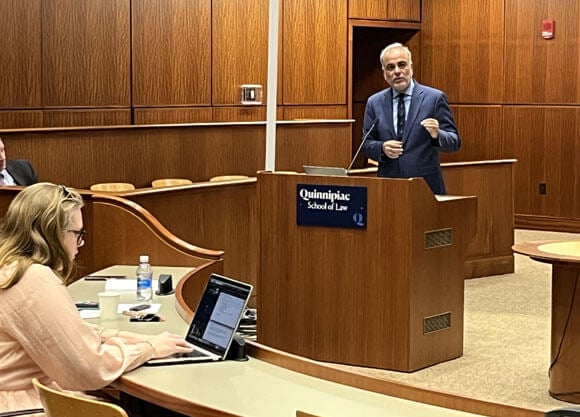
Free and open to the public, the interdisciplinary symposium held in the Brooke A. Goff Ceremonial Courtroom at Quinnipiac University School of Law addressed key questions surrounding private equity ownership. The March 26 event aimed to provide a balanced, evidence-based exploration of the issues and their implications for patients, providers and regulators alike, said Leonard Dwarica, Esq., distinguished practitioner in residence and director of the Center for Health Law and Policy.
“This symposium reflects Quinnipiac’s commitment to convening interdisciplinary conversations on some of the most pressing issues in healthcare today,” Dwarica said. “By bringing together leaders in law, medicine and government, we aim to foster thoughtful dialogue and better inform policy and practice.”
Private equity investment has grown significantly in recent years, playing an increasing role in healthcare including acquisitions of physician’s practices, hospice, nursing homes and in vitro fertilization facilities. The rise in private equity investment in healthcare is raising important questions about access, affordability and quality of care.
Quinnipiac University School of Law Dean Brian Gallini recognized Dwarica for organizing the symposium’s full and thoughtful program, which drew a broad audience as well as media interest. Media outlets covering the symposium included national legal news source Law360 and a live broadcast carried by CT-N.
“I think their presence really underscores the importance of these issues and Quinnipiac University’s role at the center being the convener of having informed interdisciplinary dialogue like this one,” Dean Gallini said.
The symposium offered perspectives from physicians, legal experts, practitioners and policymakers including State Senator Saud Anwar, MD, chair of the Public Health Committee.
Anwar discussed legislative efforts to regulate private equity ownership of healthcare facilities and shared some sobering statistics showing private equity ownership becoming an independent risk factor for patient outcomes in inpatient settings. While quality criteria and other outcomes have not yet shown change in outpatient settings owned and managed by private equity firms, costs have risen more in outpatient settings involving private equity firms. Additionally, workforce and physician distress and dissatisfaction is significant across inpatient and outpatient care facilities owned and managed by the private equity model.
Sen. Anwar and other speakers also discussed the bankruptcy of Prospect Medical Holdings, which has triggered a major healthcare crisis in Connecticut. Prospect’s January 2025 Chapter 11 bankruptcy filing was driven by nearly $500 million in debt and over $127 million in unpaid state taxes, and deeply impacted three Connecticut hospitals. After a high-profile $435 million sale to Yale New Haven Health collapsed in 2025, the state’s medical infrastructure underwent a significant restructuring to preserve essential services. Under new agreements effective in 2026, Hartford HealthCare acquired Manchester Memorial and Rockville General hospitals, though the latter remains limited to emergency and behavioral health service. UConn Health moved to take over Waterbury Hospital in a complex deal potentially worth up to $500 million.
“The scary thing is, legally, today, anyone like Prospect can still come to the state of Connecticut and buy a hospital that’s for sale. Thankfully they are in better shape, and everything is moving in the right direction, but it took a lot of effort and a lot of people,” Sen. Anwar said, later stating, “We cannot run healthcare like you run a hedge fund, because when the hedge fund balance sheets win, the patients can lose.”
Sen. Anwar also discussed two bills in Connecticut’s 2026 legislative session, Senate Bill (S.B.) 196 and House Bill (H.B.) 5045. Raised by the Senate Public Health Committee, S.B.196 would permit hospitals experiencing financial distress to enter into sale-leaseback agreements under certain circumstances and require hospitals to submit attestations that no private equity entity has a controlling interest in the hospital or interferes with the professional judgment or clinical decision-making of certain health care providers.
Fostered by Governor Ned Lamont, H.B. 5045 seeks to overhaul the Certificate of Need process by replacing the Office of Healthcare Strategy with a three-person state agency panel to expedite approvals. The legislation aims to modernize oversight by reducing the number of categories requiring review while strengthening scrutiny on hospital transfers, private equity transactions, and large asset transfers.
Speaker Khuram Ghumman, MD, Family Medicine Clerkship Director at Quinnipiac Netter, provided an in-depth overview of the reasons why physicians and providers find private equity ownership necessary. Primary factors involve clinical practice evolution, insurers/pay barriers, regulatory challenges and the need for capital.
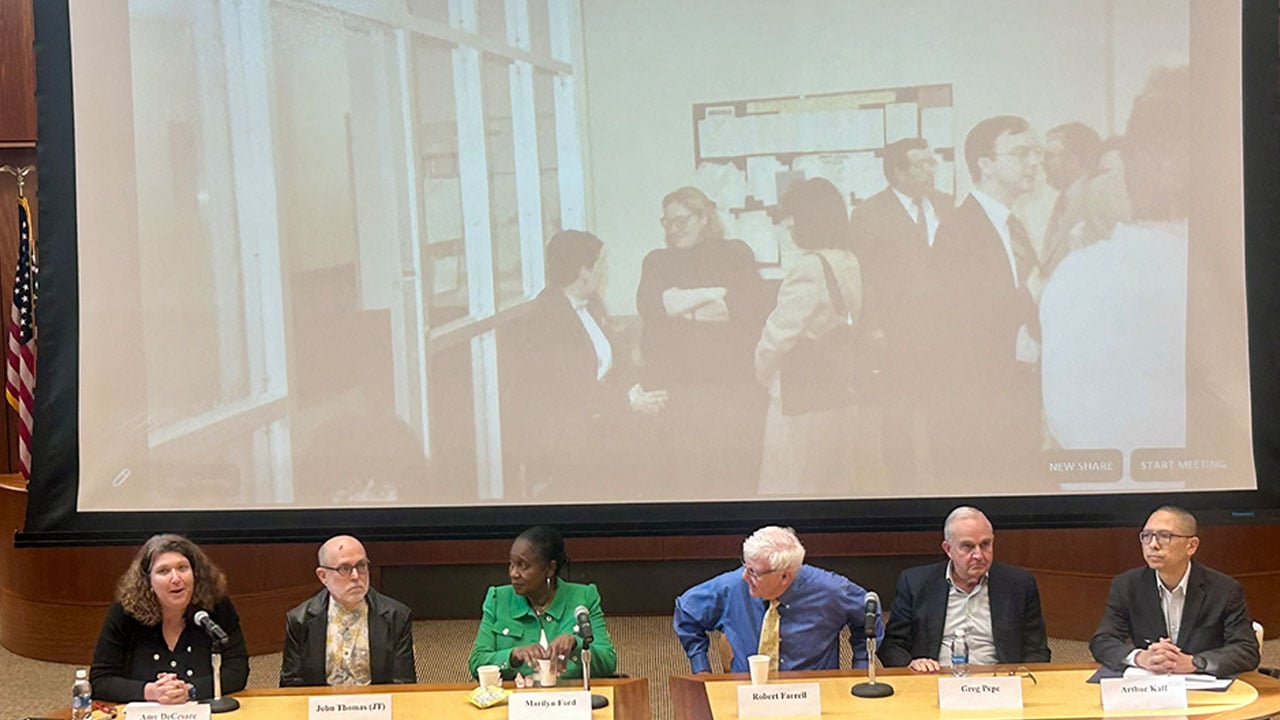
“The reason I wanted to bring the picture to all of us is so that we can build upon this in our next conversations. It has been very challenging to stay in clinical practice providing good care to your communities independently,” said Ghumman.
Ghumman joined the evening’s medical panel discussion on the pros and cons of private equity ownership. The panel was moderated by Joel Reich, MD, assistant clinical professor at Quinnipiac Netter. Additional panelists were Traci Marquis Eydman, MD, associate professor of Family Medicine Residency and inaugural program director, Rural Family Medicine Residence Program at Quinnipiac Netter; and Jeffry Nestler MD. Dr. Nestler is president of Connecticut GI and co-physician-in-chief for Hartford HealthCare Digestive Health Institute.
Additionally, a presentation by the law school’s Distinguished Practitioner in Residence, Robert White, Esq., provided insight into why private equity firms become involved in healthcare, and the process involved when private equity ownership declares bankruptcy.
In the past decade, private equity has invested $1 trillion in healthcare, with about 20% of for-profit hospitals owned by private equity. Most acquired hospitals did not become financially troubled, White noted.
“The attraction is that healthcare is recession-resistant, is growing because of an aging population, and provides opportunities for improvement through elimination of inefficiencies,” White said.
However, two recent hospital bankruptcies, Prospect Medical and Massachusetts-based Steward Healthcare, have called into question whether the private equity model is appropriate for maintaining quality patient care in hospitals.
The evening’s legal panel delved into anti-trust impact on competition and representing the private equity purchaser. In addition to White, panelists included Nicole Demers, Deputy Associate Attorney General/Chief of Antitrust Section, State of Connecticut: and Chad D. Ehrenkranz, Partner, Sidley Austin LLP. The legal panel was moderated by Angela Mattie, Esq., professor of management at Quinnipiac Netter and Quinnipiac School of Business.
Dwarica thanked each of the symposium’s experts for engaging in a thorough exchange of information which fostered robust audience participation.
“We’ve had some wonderful discussions from really qualified, wonderful people,” Dwarica said. “Sometimes, with a program like this, you get more questions than answers; but I think the questions need to be asked, and I think that we heard some really good questions.”




























Quinnipiac Today is your source for what's happening throughout #BobcatNation. Sign up for our weekly email newsletter to be among the first to know about news, events and members of our Bobcat family who are making a positive difference in our world.
Sign Up Now