

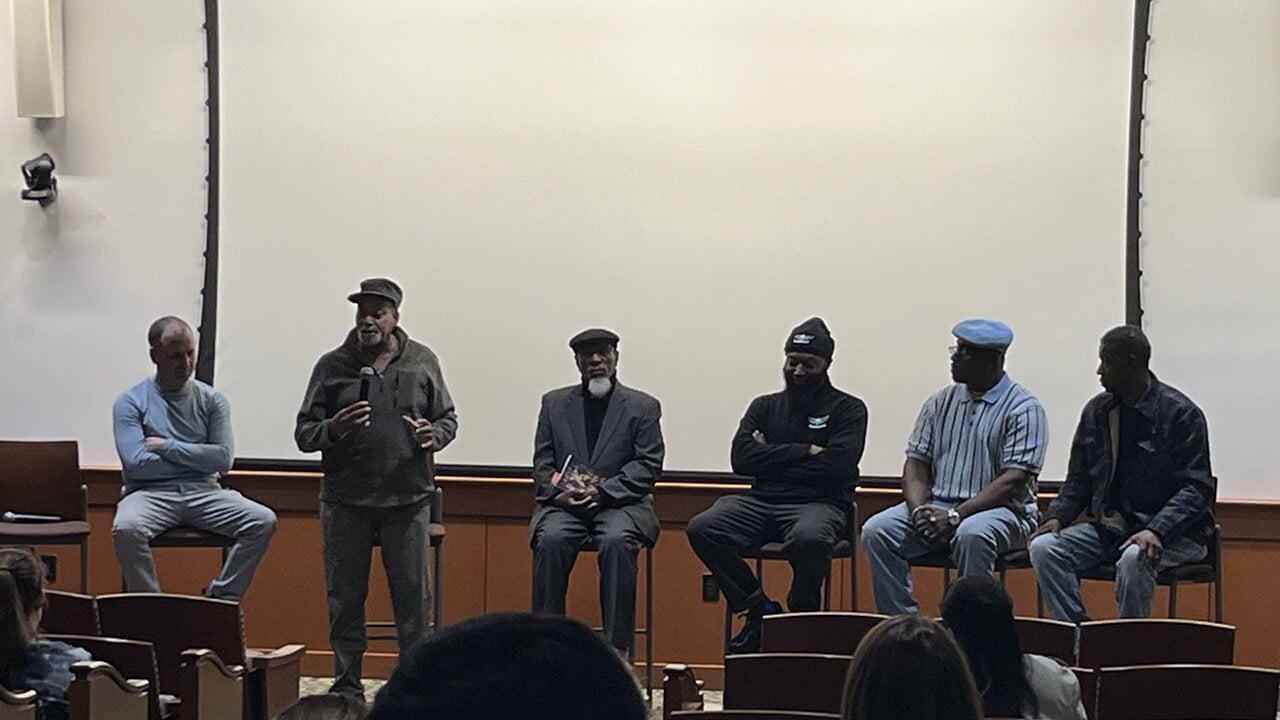
Through personal stories and first-hand accounts, cast members Babatunde Akinjobi, Tabari “Ra” Hashim, Jimmy Robinson, Abdullah Shabazz and Vance Solman discussed their lives before, during, and after incarceration. Today, the men serve their communities in roles which include those of mentor, life coach, workshop facilitator, faith leader, poet and podcaster.
The film’s potent story highlights the transformative role of education, storytelling, and second chances. Within the one-hour documentary, each man’s unique story is threaded by a common theme: the dehumanizing nature of the prison system, and their resolve to help and inspire others once they return home.
At one point, Solman describes the punishment and anonymity of incarceration, saying, “You feel alone. You feel nothing.” In another powerful moment, Shabazz describes years of fatherhood he can’t reclaim, and how the isolation of imprisonment impacts family members as much as inmates. Their unvarnished descriptions of prison life bring into sharp focus a system which prioritizes punishment and anonymity over problem-solving, rehabilitation, and policy change.
In dialogue with the Quinnipiac audience, Akinjobi discussed finding consistency after incarceration to fulfill his intention of engaging in a renewed life with his family and supporting others.
“When you’re in prison, you plan things. When you get out here, you see the obstacles are a lot harder than you expected. But that didn’t deter me. I was determined to walk my walk, to maintain my faith, and to stand as a man. Not as the idea of man, but to be a provider, to be a spiritual leader; to add to other people and to give of myself genuinely,” Akinjobi said.
Released in 2024, the documentary film emerged out of a series of live performances developed through a collaborative effort of EMERGE Connecticut, Quinnipiac University and New Haven filmmaker Travis Carbonella.
EMERGE supports formerly incarcerated people returning to New Haven after incarceration. Through workforce training and trauma-informed supportive services in a peer environment, they assist people in making a successful and healthy return home. The holistic approach to this work leads to long-term employment and dramatically lower recidivism rates for the crew members.
In 2018, the idea of sharing the stories of EMERGE associates was initiated by EMERGE Board Chairman Don C. Sawyer III, who was also vice president for equity, inclusion and leadership development at Quinnipiac and a sociology professor during his 11 years with the university.
Featuring a different cast of EMERGE associates, the first live production of “As We Emerge: Monologues of the Formerly Incarcerated” was developed and performed at Quinnipiac in 2019. Stephen McGuinn, professor of criminal justice, Rose Bochansky, technical director of visual and performing arts, and Quinnipiac students worked with cast members to develop their personal stories into the script.
In 2023, McGuinn, Bochansky, and Quinnipiac students worked with Akinjobi, Hashim, Robinson, Shabazz and Solman to craft interviews about their lived experiences into live performances presented at Quinnipiac’s Theatre Arts Center in Hamden. Carbonella filmed the cast rehearsing and performing at Quinnipiac, and in their daily lives at home and work. The combination of settings amplify the simple sense of freedom each man had waited years to regain.
Amber Kelly, social work professor and director of Quinnipiac’s Prison Education and Community Engagement initiative, works on projects in collaboration with EMERGE. On March 24, Kelly welcomed the cast, McGuinn, Sawyer, event speakers, EMERGE members, students, faculty and staff to Quinnipiac’s Frank H. Netter MD School of Medicine on the North Haven Campus for the afternoon screening and talk. Carbonella joined the cast on March 24 during the evening screening and Q&A held at the School of Business on the Mount Carmel Campus.
Dr. Lisa Coplit, dean of Frank H. Netter MD School of Medicine, said the documentary is especially meaningful because it began within Quinnipiac’s academic community.
“What started as classroom project grew into a collaboration among students and theatre artists and formerly incarcerated men, who transformed personal interviews into powerful monologues performed by the men themselves. The film captures that journey, and the humanity, resilience and hope within these stories,” Coplit said.
Coplit said the stories shared by the five cast members illustrate the transportive power of education and storytelling.
“They invite us to listen more deeply and to challenge our assumptions and to better understand the experiences of people whose paths may be very different than our own,” Coplit said.
Coplit said understanding the perspective of patients in order provide the best possible care is a fundamental concept taught to Quinnipiac medical school students. School of Nursing dean Larry Slater said the film’s inspirational message also aligns with the nursing school’s teaching approach grounded in holism, student self-reflection and community service.
“Most critical to that is helping them understand and reflect on those populations that we don’t think about — those that are the most vulnerable, those that are most at risk, and those that are invisible,” Slater said. “This film and these experiences are exactly what we try to educate our students to do – to be able to tell your stories, to tell the stories of their patients, their communities, their families and their people; because that is when we are truly going to have an impact.”
School of Health Sciences associate dean Stephen Straub invited the audience to consider that there are currently 1.8 million incarcerated people in the U.S. as of January 2026.
“What are we counting? We’re counting individuals. We’re counting human beings. And each one of those human beings has a history. They have a family. They have a story behind who they are and what is going on in their life,” Straub said.
In response to a question from the Quinnipiac audience on how social workers can better assist people returning from incarceration, Hashim said patience and respect for each person’s lived experience is required. He said his seven years of incarceration was shaped by “23 and one” – 23 hours of confinement and one hour of activity outside his room
“There’s something that everyone in this room can do – you can wake up and go to the kitchen, you can wake up and go to your car, you can wake up and go to Starbucks. We have to sit in that room for 23 hours and contemplate what I’m going to do today. And they’re taking your name, they’re taking your identity and they want you to be another number and make sure you never forget that. So you’re not the person you used to be back in the day. You’re an object,” said Hashim. “And we’re all supposed to be humans, at the end of the day. So be patient with these brothers. Think about their battles, each and every day.”
In this Article
Read This Next




















Stay in the Loop
Quinnipiac Today is your source for what's happening throughout #BobcatNation. Sign up for our weekly email newsletter to be among the first to know about news, events and members of our Bobcat family who are making a positive difference in our world.
Sign Up Now