



Engineering students to design, race electric boat in national naval competition
February 27, 2026
February 27, 2026
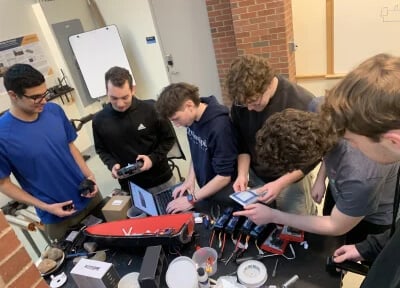
Seven students — six mechanical engineering majors in the second year of the university’s 3+1 program and one civil engineering sophomore — will compete in the 2026 Promoting Electric Propulsion (PEP26) challenge, funded by the U.S. Office of Naval Research. The event will be held April 14-16 at Portsmouth City Park in Portsmouth, Virginia.
Team members include Zachary Chapman, Conner Kass, Cole McKirryher, Marc Needleman, Neal Kapadia, Johnathon Thor and Christopher Parisi.
The group will enter the contest’s “Budget Warrior” division, which tasks collegiate teams with designing and racing a remote-controlled craft costing less than $1,500. Boats must convert a power supply of 55 volts or less into maximum speed while carrying a 30-pound payload, emphasizing efficiency, engineering design and performance.
The American Society of Naval Engineers is providing each participating team $7,000 to support construction as well as travel and lodging for the competition.
Assistant Professor of Mechanical Engineering Cameron LaMack said the students themselves drove the project from the start. Competition organizers contacted the university about potential participation at the same time students independently discovered the event and asked faculty to support a team.
“This is very much a student-run effort,” LaMack said. “They are eager and motivated, and they’ve taken ownership of every stage — design, fabrication and testing.”
The team has relied heavily on Quinnipiac’s MakerSpace facilities, where Chapman serves as a trained “superuser,” allowing rapid prototyping and iteration of components. Students also consulted Associate Teaching Professor Jose Riofrio for mechatronics and remote-control systems guidance and sought design advice from mechanical engineering alumnus and professional-in-residence Drew Peccerillo.
Despite early funding delays that slowed initial progress, the School of Engineering supported the project to ensure students could move forward with the hands-on learning experience.
LaMack said the competition reflects the department’s emphasis on experiential education.
“The heart of our program is project-based learning,” he said. “Opportunities like this allow students to apply classroom knowledge to a real engineering challenge with clear performance goals and real-world constraints.”
The PEP competition focuses on electric propulsion technologies — a growing area in maritime engineering — while exposing students to naval design principles, systems integration and teamwork under competitive conditions.



























Quinnipiac Today is your source for what's happening throughout #BobcatNation. Sign up for our weekly email newsletter to be among the first to know about news, events and members of our Bobcat family who are making a positive difference in our world.
Sign Up Now